Visivra Official Website › Blog › Lutein and Zeaxanthin Capsules: How Visivra's Six Names Compare With AREDS-Style Formulas
Lutein and Zeaxanthin Capsules: How Visivra's Six Names Compare With AREDS-Style Formulas
If you search for a lutein and zeaxanthin capsule you will meet the word AREDS within a few clicks. It is on the box of many products, and on the websites of others that merely mention it. This page lines up the six names on the Visivra bottle beside what the AREDS trials used, so you can see what they share, what they do not, and what the label leaves blank.
Visivra is not an AREDS or AREDS2 formula. It shares lutein, zeaxanthin and zinc by name with those trials, adds bilberry and astaxanthin, names vitamin A without its form, and prints no amounts. The trials used stated doses, so their results cannot be set beside this label.
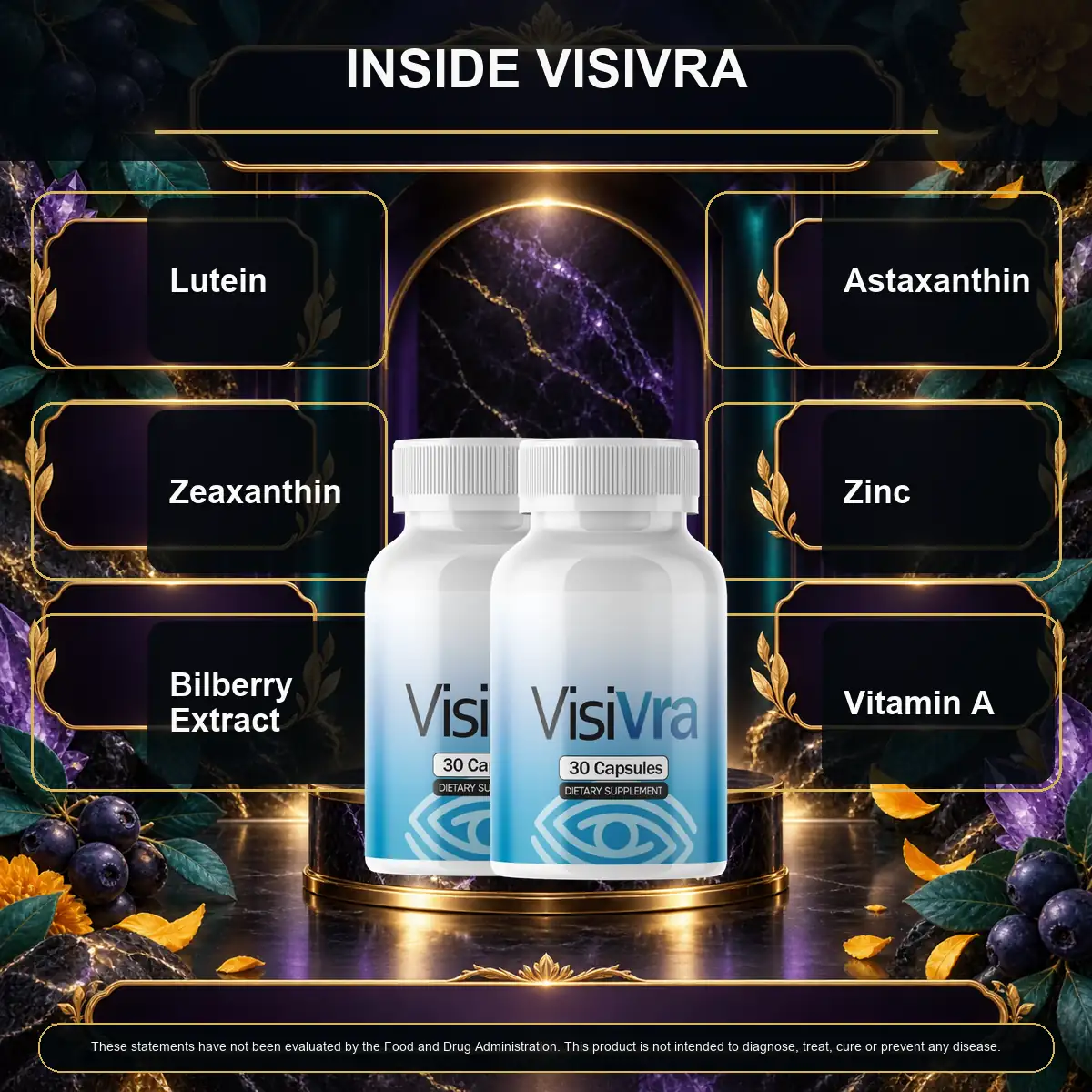
- Six named actives: lutein, zeaxanthin, bilberry extract, astaxanthin, zinc and vitamin A. No amount is printed for any.
- AREDS2 used lutein 10 mg and zeaxanthin 2 mg a day for five years, in people who already had intermediate AMD.
- The original AREDS gave zinc 80 mg with copper 2 mg a day. AREDS2 also tested a 25 mg zinc arm.
- AREDS2 removed beta carotene after CARET and ATBC found more lung cancer in smokers who took it.
- Copper is not among the six Visivra names. The vitamin A form is not stated.
- Visivra is not a drug, is not FDA approved, and does not treat or prevent macular degeneration.
Is Visivra an AREDS or AREDS2 vision supplement?
No, we do not describe it that way. AREDS2 is a specific combination at specific amounts, tested in people who already had intermediate age-related macular degeneration, or the advanced form in one eye. Two of its ingredients appear on the Visivra bottle by name. That is not the same as matching the formula.
The word AREDS gets used loosely. Some products are built to a trial formula and print the amounts. Others borrow two or three ingredient names. A buyer can tell the difference only by reading the panel. On this bottle there is no panel, so the question cannot be settled from the label, and we leave it unanswered rather than guess. Our post on what AREDS2 actually tested covers the trial itself.
What are the six names, and what did trials use for each?
| Ingredient | On the Visivra label | What a published trial used |
|---|---|---|
| Lutein | No amount | 10 mg a day for five years in AREDS2; the same 10 mg in CREST |
| Zeaxanthin | No amount | 2 mg a day in AREDS2, always alongside lutein; a dose comparison looked at other amounts |
| Bilberry extract | No amount | 240 mg a day for 12 weeks; 480 mg a day for 8 weeks in screen workers |
| Astaxanthin | No amount | 4 mg a day for 84 days, in children |
| Zinc | No amount, and no copper named | 80 mg with copper 2 mg in AREDS; AREDS2 also tested a 25 mg arm |
| Vitamin A | No amount, and no form | No trial amount to print. AREDS2 took beta carotene out |
These are the amounts the trials used, for comparison only. Visivra is not any of those formulas and does not inherit their findings.
The right-hand column is there for one reason. In this category the amount is the evidence. A reader holding an unlabelled bottle should be able to see what the figure would have to be for a comparison to mean anything. We never estimate what is in a capsule.
Ask the four questions, then decide
The order desk holds the amounts the label leaves out. The official checkout shows the live price and the guarantee in full.
Two bottles $158 · three bottles $207 · six bottles $294 · 60-day money-back guarantee
See today’s price and guaranteePrices as read on 18 September 2026; the checkout shows the current price. Disclosure: Myvisivra is paid when an order is placed through the seller’s checkout.
Why do lutein and zeaxanthin travel as a pair?
They are structural twins, differing by the position of one double bond. Both are yellow carotenoids. Lutein collects in the macula as part of the yellow pigment layer. Zeaxanthin dominates the very centre, where lutein thins out. In supplements they usually come from the same marigold extraction, which is why the two names almost always appear together.
Their trial history is joined too. The 2 mg of zeaxanthin in AREDS2 was never given on its own, so the honest way to describe that evidence is as a pairing, not as two findings. The AREDS2 report No. 3 examined the effect of lutein and zeaxanthin in particular. Another study, the three-carotenoid trial, tested astaxanthin alongside lutein and zeaxanthin rather than on its own.
One more point on form. Marigold lutein comes free or as an ester that the gut has to cleave first, and the two behave differently in the blood, as a study of lutein forms shows. On the Visivra bottle the word lutein stands alone, and the form is left open.
How does the Visivra list compare with a typical AREDS2-style formula?
| What you find | Typical AREDS2-style formula | Visivra |
|---|---|---|
| Named actives | Six to eight, led by lutein and zeaxanthin | Six, led by lutein and zeaxanthin |
| Carotenoid pairing | Lutein with zeaxanthin, sometimes meso-zeaxanthin | Lutein with zeaxanthin |
| Mineral content | Zinc, usually with copper alongside it | Zinc. Copper is not among the six names |
| Vitamin A | Removed from AREDS2 formulas after 2013 | Present, with the form left open |
| Amounts on the pack | Printed as a Supplement Facts panel | Names only |
| Extras | Often vitamin C, vitamin E, omega-3 | Bilberry and astaxanthin instead |
The left column describes the commonest shape of product in the category, not a specific competitor. We do not compare named rival brands.
Two rows are the interesting ones. Bilberry and astaxanthin are not AREDS2 ingredients. They come from the eye-strain side of the field, with different endpoints. That suggests a formula aimed at people who work at a display more than at people under an eye clinic's care. The other is vitamin A, which cuts the other way, and the next section explains why.
Why do the missing copper and the open vitamin A form matter?
Zinc has a real ceiling. The Institute of Medicine chapter sets the adult tolerable upper intake at 40 mg a day from all sources. AREDS exceeded it on purpose, under supervision, and paired it with 2 mg of copper, because sustained high zinc intake lowers copper status over months. A published case shows where that can lead, and a controlled trial found no change in sensitive copper markers in healthy participants. Dose and duration decide which picture applies. We cannot say which applies here, because the label prints no zinc amount. Our zinc and copper post explains.
Vitamin A is one word for several molecules. Preformed vitamin A means retinol and its esters. Provitamin A means beta carotene and its relatives. MedlinePlus sets out the difference. The original AREDS formula carried beta carotene at 15 mg. It was dropped after CARET and ATBC found more lung cancer in smokers who took it. The AREDS2 ten-year follow-up, report 28, counted 23 lung cancers in the beta carotene arm against 11, with an odds ratio of 1.82. Anyone who smokes or used to should establish the form of the vitamin A before taking any eye supplement. The vitamin A post has the whole story.
Where does each ingredient come from?
- Lutein: a yellow pigment the body cannot build. Supplement lutein is most often taken from marigold petals.
- Zeaxanthin: usually from the same marigold extraction. In food it turns up in corn, orange peppers and goji berries.
- Bilberry extract: Vaccinium myrtillus, a small dark European berry, normally standardised to an anthocyanin percentage.
- Astaxanthin: a red-orange carotenoid produced from the freshwater alga Haematococcus pluvialis.
- Zinc: an essential trace mineral, usually as an oxide or a gluconate.
- Vitamin A: retinol and its esters from animal foods, or beta carotene from plants.
These descriptions are general. The exact source, form and extract standardisation used in a Visivra capsule are not published on the label. The order desk holds the specification. The vegetarian mark suggests a plant-derived shell and nothing more.
How do you compare any lutein and zeaxanthin supplement fairly?
- Does it print an amount for lutein and for zeaxanthin? Compare with 10 mg and 2 mg.
- Does it say free lutein or ester, and where the zeaxanthin comes from?
- Does it print zinc, and does it pair it with copper?
- Which form of vitamin A is it, and is beta carotene present?
- Is the lot tested, and is the certificate available?
- Would it duplicate a formula an eye clinic already recommended?
Run those six questions on every bottle you consider, ours included. We would rather you compare with a clear head than choose on a logo. Our scorecard post has a longer version. And if you have a diagnosed eye condition, ask your eye doctor first.
Which sources sit behind this article?
Every study named in this article is one of the sources already cited across this website. Each link opens the public record. The studies tested single ingredients at stated amounts. None of them tested the finished Visivra capsule.
- The AREDS2 trial. https://pubmed.ncbi.nlm.nih.gov/23644932/
- The CREST trial. https://pubmed.ncbi.nlm.nih.gov/27367585/
- A zeaxanthin dose comparison. https://pubmed.ncbi.nlm.nih.gov/35044504/
- The original AREDS trial. https://pubmed.ncbi.nlm.nih.gov/11594942/
- AREDS2 report No. 3. https://pubmed.ncbi.nlm.nih.gov/24310343/
- A three-carotenoid trial. https://pubmed.ncbi.nlm.nih.gov/34376917/
- A study of lutein forms. https://pubmed.ncbi.nlm.nih.gov/38794653/
- The Institute of Medicine zinc chapter. https://www.ncbi.nlm.nih.gov/books/NBK222317/
- A case of zinc-driven copper loss. https://pubmed.ncbi.nlm.nih.gov/34912740/
- A controlled zinc trial. https://pubmed.ncbi.nlm.nih.gov/23303874/
- MedlinePlus. https://medlineplus.gov/ency/article/002400.htm
- The CARET trial. https://pubmed.ncbi.nlm.nih.gov/8602180/
- The ATBC trial. https://pubmed.ncbi.nlm.nih.gov/8127329/
- AREDS2 report 28. https://pubmed.ncbi.nlm.nih.gov/35653117/
Frequently asked questions
Is Visivra an AREDS vision supplement?
No. AREDS2 is a specific combination at specific amounts tested in people with intermediate AMD. Visivra shares lutein, zeaxanthin and zinc by name, adds bilberry and astaxanthin, and prints no amounts.
How much lutein and zeaxanthin is in Visivra?
Not published. The label names both and prints no amount. For comparison, AREDS2 used lutein 10 mg and zeaxanthin 2 mg a day. That is a trial amount, not an estimate of what is in a capsule.
What are the Visivra ingredients?
Six: lutein, zeaxanthin, bilberry extract, astaxanthin, zinc and vitamin A. The bottle artwork, the vendor's ingredient tile and the seller's page agree on the six.
Does Visivra contain copper or beta carotene?
Copper is not among the six names. Vitamin A is named without its form, so we cannot say whether beta carotene is present. The order desk holds the specification.
Can I take Visivra with an AREDS2 supplement?
Both share lutein, zeaxanthin and zinc. An AREDS2 formula is built around a fixed total, so ask the eye clinic that recommended it before adding a second product.
How does Visivra compare with other lutein and zeaxanthin supplements?
We hold no facts on rival brands, so we do not compare them. Use the six questions above on any bottle: amounts, forms, zinc and copper, vitamin A form, testing and overlap.
Our view
Lining a label up beside a trial is a useful discipline, and it shows plainly where this label stops. Visivra names the right kind of ingredients for a lutein and zeaxanthin capsule. It does not give the numbers that would let you compare it with the trials that made those ingredients famous.
That gap can be closed by one phone call. Ask about the lutein form, the zinc amount, the copper and the vitamin A form. Then decide. If the answers are clear, you know more than the bottle tells you. If they are vague, you have saved yourself some money.
Visivra is a dietary supplement. It is not FDA approved, and no supplement is. It does not treat, cure or prevent any disease, including macular degeneration.
Compare with a clear head
Run the six questions, make the call, and use the 60-day window if you try it. The seller's checkout shows today's price and terms.
Two bottles $158 · three bottles $207 · six bottles $294 · 60-day money-back guarantee
See today’s price and guaranteePrices as read on 18 September 2026; the checkout shows the current price. Disclosure: Myvisivra is paid when an order is placed through the seller’s checkout.
Last updated