Visivra Official Website › Ingredients
IngredientsVisivra Ingredients
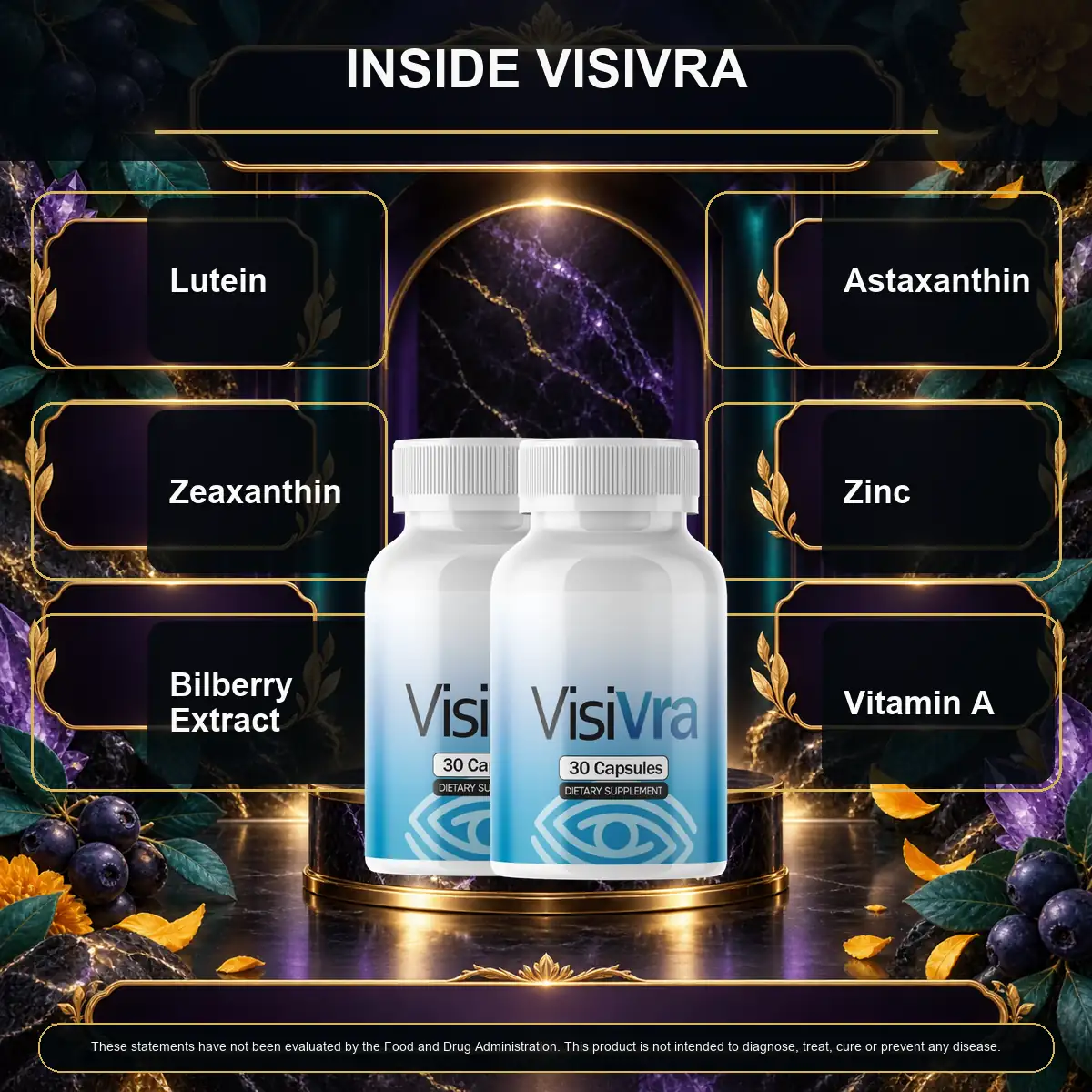
Six actives are named on the Visivra bottle.
They are lutein, zeaxanthin, bilberry extract, astaxanthin, zinc and vitamin A, in that order, and the bottle artwork, the vendor's ingredient tile and the seller's page all give the same six. Each one has human eye research behind it, and this page sets out what that research used.
What is in the bottle, where each one belongs in the eye, and the amount each one was studied at.
What are the ingredients in Visivra?
Six actives, in the order the artwork prints them, with what each one is.
| # | On the label | What it is | Where it acts in the eye |
|---|---|---|---|
| 1 | Lutein | A yellow xanthophyll carotenoid, usually from marigold | The macula, as part of the yellow pigment screen |
| 2 | Zeaxanthin | Lutein's structural twin, from the same extraction | The very centre of the macula, where lutein thins |
| 3 | Bilberry Extract | A European berry standardised for anthocyanins | The ciliary muscle and the focusing response, in the modern trials |
| 4 | Astaxanthin | A red-orange carotenoid from a freshwater alga | Studied for eye strain rather than for macular pigment |
| 5 | Zinc | An essential trace mineral, usually as an oxide or a gluconate | Enzyme cofactor in the retinal pigment epithelium |
| 6 | Vitamin A | A family of molecules: retinol, retinyl esters, beta carotene | Rhodopsin, the photoreceptor molecule that responds to light |
The six names come from the bottle's own INSIDE VISIVRA artwork and from the seller's page, which agree with each other exactly.
Six is a short list for this category and that is a point in its favour. A 25-name panel splits a fixed capsule between so many rows that most of them arrive at a quantity nobody would study, and a short list at least leaves room for the ones that matter.
The six chosen here are also the right six. Every one of them has published human eye research behind it rather than a mechanism borrowed from another organ, which is more than can be said for the bilberry-and-eyebright formulations that circulated in this category for years.
What a reader gets from the list, then, is the composition. What decides how far the research travels is the quantity, and the Visivra label leaves that figure open. The section headed honest dosage analysis further down sets out exactly what that means and what it does not.
Visivra ingredients, one at a time
What each one is, where it comes from, and which studies put it on eye labels.
Lutein
a xanthophyll carotenoidNamed on the label; no figure givenA yellow pigment the body cannot build and has to eat. Kale, spinach and egg yolk are the usual dietary routes, and supplement lutein is most often taken from marigold petals as either free lutein or a lutein ester that the gut has to cleave first. Once absorbed it collects in one place above all others: the centre of the macula, where it forms part of the yellow screen sitting in front of the photoreceptors.
That concentration is the reason it is on eye labels at all. AREDS2 ran 10 mg a day for five years and is why the ingredient is now near-standard in the category, while the CREST trial used the same 10 mg alongside zeaxanthin and meso-zeaxanthin and measured contrast sensitivity in people with healthy retinas.
Marigold-derived lutein comes in two forms and they absorb differently: a comparison of free lutein against the ester found the two behave unlike one another in the bloodstream. Visivra prints the word Lutein and leaves the form open.
Zeaxanthin
the macula's central pigmentNamed on the label; no figure givenLutein's structural twin, differing by the position of one double bond, and the pigment that dominates the very centre of the macula where lutein thins out. Corn, orange peppers and goji berries carry it in food. In supplements it usually arrives from the same marigold extraction that supplies the lutein, which is one reason the two names almost always appear together on a label.
Its trial history is joined at the hip to lutein's. The 2 mg in AREDS2 was never given on its own, so the honest way to describe that evidence is as a pairing rather than as two separate findings. A dose comparison looked at what different zeaxanthin amounts do to macular pigment, which is the measurement this ingredient is judged on.
On this bottle zeaxanthin sits second in the list, directly under lutein, in the order the category conventionally writes them.
Bilberry Extract
Vaccinium myrtillus, fruitNamed on the label; no figure givenA small dark European berry, a close relative of the blueberry, whose skin carries anthocyanins: the deep blue-purple pigments that give it the colour. Extracts are normally standardised to an anthocyanin percentage, and that percentage matters more than the weight beside it, because a 25 per cent extract and a 1 per cent extract deliver wildly different quantities of the same compound at the same milligram.
Modern bilberry research in eyes is not about night vision. A twelve-week randomised trial gave 240 mg a day and looked at ciliary-muscle function, the small ring of muscle that changes the lens shape for near work, and a trial in screen workers gave 480 mg a day for eight weeks to people who spend their working day at a display.
The night-vision story is the famous one and it did not survive testing: a systematic review found the positive results sat in the uncontrolled studies. This website does not repeat it.
Astaxanthin
a red-orange carotenoidNamed on the label; no figure givenThe pigment that makes salmon flesh pink and cooked shellfish red, produced commercially from the freshwater alga Haematococcus pluvialis. Chemically it belongs with lutein and zeaxanthin but it behaves differently in the eye: it does not build up in the macular pigment, and the work on it points at the focusing apparatus and at eye strain instead.
The cleanest recent trial is a 2025 randomised study that gave 4 mg a day for eighty-four days and measured digital eye strain. Its participants were children, which is worth knowing when the same compound is sold in a capsule for adults. A three-carotenoid trial tested it alongside lutein and zeaxanthin rather than on its own.
A review of the compound covers the wider literature, much of which is laboratory work on oxidation rather than clinical outcomes in people.
Zinc
an essential trace mineralNamed on the label; no figure givenA mineral the retina holds in unusually high concentration, where it is a cofactor for the enzymes that recycle vitamin A between its used and unused forms after light hits a photoreceptor. That housekeeping role, rather than anything more dramatic, is why zinc has been in eye formulas since the 1990s.
The original AREDS trial gave 80 mg of zinc a day as zinc oxide, together with 2 mg of copper as cupric oxide. The copper was deliberate: sustained high zinc intake drives copper down over months, and a documented case shows where that can lead. AREDS2 later tested a 25 mg arm as well.
Zinc also has a ceiling that the other five do not. The Institute of Medicine chapter sets the adult tolerable upper intake at 40 mg a day from all sources combined, a figure the AREDS formula exceeds on purpose and under supervision.
Vitamin A
the retinal vitaminNamed on the label; no figure givenThe one ingredient on this list whose name covers several different molecules. Retinol and retinyl esters are preformed vitamin A from animal foods. Beta carotene is a plant precursor the body converts as it needs it. MedlinePlus sets out the difference plainly, and it is not a technicality: the two behave differently at high intakes and in different people.
Vitamin A earns its place in an eye formula honestly. Bound to a protein in the photoreceptors it becomes rhodopsin, the molecule that responds to a photon, and severe deficiency is a genuine cause of blindness in parts of the world.
It is also the ingredient AREDS2 took out. The original formula carried beta carotene 15 mg; it was dropped after CARET and ATBC found more lung cancer among smokers in the supplemented arms. That history is set out on the side effects page, where it belongs.
Read the six cards together and a pattern shows: two pigments that accumulate in one specific spot, one berry extract whose modern trials are about focusing, one alga carotenoid studied for strain, one mineral doing enzyme work, and one vitamin with a long and complicated history in this exact context.
Where each Visivra ingredient sits in the eye
Three separate structures, and which of the six belongs to each.
The macula is a patch about five millimetres across at the back of the eye, and its central few degrees do all the detailed work: reading, faces, the number on a bus. Lutein and zeaxanthin collect there in a measurable layer called macular pigment optical density, which absorbs short-wavelength light before it reaches the photoreceptors underneath.
The ciliary muscle is somewhere else entirely, a ring at the front of the eye that squeezes the lens into a rounder shape for close work and relaxes it for distance. That is the structure the bilberry trials measured, and it is why bilberry belongs to a different conversation from the carotenoid pair.
The retinal pigment epithelium is the single layer of cells behind the photoreceptors that recycles their spent material, and it is the zinc-dependent part of the machinery. Vitamin A is the raw material passing through that cycle.
What the order of the Visivra ingredient list means
What position means on a regulated panel, and what it means on a marketing tile.
On a Supplement Facts panel the order is not decorative. Regulation puts the vitamins and minerals first in a prescribed sequence, then the remaining ingredients in descending order of weight, so the top row is the heaviest and the bottom row is the lightest. Anyone used to reading panels reads position as information.
The INSIDE VISIVRA artwork is a marketing tile rather than a panel, and a tile carries no such convention. Its six names sit in gold frames in a grid, which means the order here is a design decision and a reader should treat it as one.
Lutein and zeaxanthin lead it, which is the order the whole category uses because that is the order AREDS2 wrote them in. Vitamin A sits last, where a panel would have put it first as a vitamin. Both facts say something about the artwork and nothing about what is in the capsule.
Zinc and vitamin A are the two rows on this list with an established upper intake level, and they are the two sitting at the bottom of the tile. On a real panel their position would be fixed by rule rather than chosen. That is the difference between a tile and a panel, and it is worth knowing before reading anything into the sequence.
Honest dosage analysis: the figures behind the Visivra names
The trial amounts, attributed, beside a label column that holds names only.
| Ingredient | The amount a published trial used | Which trial, and the PMID |
|---|---|---|
| Lutein | 10 mg/day | AREDS2 (PMID 23644932); CREST used the same 10 mg |
| Zeaxanthin | 2 mg/day | AREDS2 (PMID 23644932) |
| Bilberry Extract | 240-480 mg/day | 240 mg for 12 weeks (PMID 32106548); 480 mg for 8 weeks (PMID 25923485) |
| Astaxanthin | 4 mg/day | 84 days (PMID 40014233) |
| Zinc | 80 mg/day, with copper 2 mg | AREDS report 8 (PMID 11594942); AREDS2 also tested a 25 mg arm |
| Vitamin A | not a trial amount | CARET gave beta carotene 30 mg + retinol 25,000 IU and was stopped early for excess lung cancer (PMID 8602180) |
Every figure was read out of the abstract it belongs to. The right-hand column is there so a reader can open the record rather than take the number on trust.
Every figure in that table belongs to a trial rather than to this bottle, and that is the whole of the section. The label names six actives; the research behind those six names ran at the amounts printed above; and the two cannot be set beside each other because only one of them carries numbers.
That is worth saying precisely rather than dramatically. In this category the amount carries most of the evidence: lutein and zeaxanthin became eye ingredients through one trial at 10 mg and 2 mg, and a capsule holding a tenth of that is a different product wearing the same six words. Nothing on this website estimates what is in a Visivra capsule, because an estimate dressed as a figure would be worse than the gap it fills.
What can be said is what a reader should do with it. The comparison above is the reason the 60-day guarantee matters more here than it would on a labelled bottle: the window is long enough to judge the capsule by what happens rather than by arithmetic nobody can do.
- It is not saying the capsule is empty. Six actives are named by three independent sources that agree: the bottle artwork, the vendor's ingredient tile and the seller's own page.
- It is not saying the amounts are wrong. An unknown figure can be generous.
- It is saying the AREDS2 comparison cannot be made from this label, so this website never makes it.
- It is saying the 60-day window is the practical answer, and it is the reason the guarantee is described in full on its own page rather than in a footnote.
What else is inside a Visivra capsule
The capsule shell, the other-ingredients line, and what the seals imply about both.
Every capsule has a shell and almost every capsule has something holding the powder apart: a flow agent such as magnesium stearate, a bulking agent such as rice flour or cellulose, sometimes a colour. On a regulated panel those appear under a line headed Other Ingredients, beneath the actives.
The Visivra artwork carries the front panel and the ingredient tile, and neither one has that line. What the pack does carry is a vegetarian seal, and a vegetarian seal on a capsule is a claim about the shell: it says the casing is a plant-derived hydroxypropyl methylcellulose rather than bovine or porcine gelatin.
That is one useful inference from a badge, and it is the only one on the pack. The gluten-free and dairy-free seals describe the same absence from a different angle, and the seal wall is audited row by row on the testing and quality page.
| What a full panel would carry | What the pack shows | Where to get it |
|---|---|---|
| Serving size and servings per container | The front panel gives a capsule count of 30 | The order desk, on the telephone, before buying |
| An amount and a % Daily Value per active | Six names in gold frames | The seller, who holds the specification |
| An Other Ingredients line | A vegetarian seal, which speaks to the capsule shell | The bottle in hand, whose base carries the lot code |
| Allergen statements | Gluten-free and dairy-free seals on the artwork | The bottle in hand, and the order desk |
Every row in the middle column is a real feature of the pack. The right-hand column is what a buyer can do about the rest before the guarantee window opens.
A reader holding the bottle has one advantage over a reader holding the artwork: the base of the bottle carries the lot code and a best-before date, and matching those against the paperwork is what the batch verification page is for.
How the Visivra ingredient list compares with the rest of the category
Where this list sits against the shape of formula the category has settled on.
| What you find | Typical AREDS2-style formula | Visivra |
|---|---|---|
| Named actives | Six to eight, led by lutein and zeaxanthin | Six, led by lutein and zeaxanthin |
| Carotenoid pairing | Lutein with zeaxanthin, sometimes meso-zeaxanthin | Lutein with zeaxanthin |
| Mineral content | Zinc, usually with copper alongside it | Zinc, and copper is not among the six names |
| Vitamin A | Removed from AREDS2 formulas after 2013 | Present, with the form left open |
| Amounts on the pack | Printed as a Supplement Facts panel | The pack gives names |
| Extras | Often vitamin C, vitamin E, omega-3 | Bilberry and astaxanthin instead |
The left-hand column describes the commonest shape of product in this category, not a specific competitor.
Two rows there are genuinely interesting. Bilberry and astaxanthin are not AREDS2 ingredients at all: they come from the eye-strain and screen-fatigue side of the category, which is a different literature with different endpoints. Including them suggests a formula aimed at people who work at a display rather than at people already under an eye clinic's care.
Vitamin A is the row that cuts the other way. Its presence is the single thing about this list that a well-informed buyer will want to ask about before ordering, because the form decides the answer, and the reasons are set out in full on the side effects page.
The copper row is the third. AREDS paired copper with zinc on purpose, and a formula naming zinc alone leaves a question that depends entirely on how much zinc is in it.
Visivra ingredient questions, answered
How many ingredients are in Visivra?
Six actives are named: lutein, zeaxanthin, bilberry extract, astaxanthin, zinc and vitamin A. Three sources agree on that list, which is the bottle artwork, the vendor's INSIDE VISIVRA tile and the seller's own product page.
Does Visivra contain a proprietary blend?
No blend name appears anywhere on the pack, and the six actives are named individually rather than hidden inside one. A proprietary blend gives a combined weight and conceals the split; this label gives the names and leaves the split open, which is a different situation with the same practical consequence.
Is Visivra an AREDS2 formula?
It is not, and this website will not describe it as one. AREDS2 is a specific combination at specific amounts, tested in people who already had intermediate age-related macular degeneration. Two of its ingredients appear here by name, which is not the same thing as matching the formula.
What form of lutein does Visivra use?
The pack gives the word Lutein. Supplement lutein is usually either free lutein or a lutein ester requiring cleavage in the gut, and the two absorb differently. The order desk on +1 (323) 347-4522 is the place to ask, and asking before the first bottle is better than asking after it.
Is there copper in Visivra?
Copper is not one of the six names. AREDS gave copper 2 mg alongside its zinc because sustained high zinc intake lowers copper over months. How much that matters here depends on the zinc amount, which is why it is a question for the seller rather than a conclusion for this page.
Is Visivra vegetarian?
The pack carries a vegetarian seal, which on a capsule is a statement about the shell: plant-derived cellulose rather than gelatin. The same seal wall carries gluten-free and dairy-free marks. Each one is audited on the testing and quality page.
Where are the Visivra ingredients sourced from?
The pack names a manufacturing country through its made-in-the-USA seal and an FDA-registered facility roundel, both of which are statements about where a product is made rather than about where a raw material was grown. Marigold lutein and algal astaxanthin have global supply chains, and the origin of each is a question for the order desk.
Sources for the Visivra ingredient list
Each study named above, in the order of the ingredient it belongs to.
- Age-Related Eye Disease Study 2 (AREDS2) Research Group. Lutein + zeaxanthin and omega-3 fatty acids for age-related macular degeneration: the Age-Related Eye Disease Study 2 (AREDS2) randomized clinical trial. JAMA. 2013;309(19):2005-15. PMID 23644932. https://pubmed.ncbi.nlm.nih.gov/23644932/
- Nolan JM, Power R, Stringham J, et al. Enrichment of macular pigment enhances contrast sensitivity in subjects free of retinal disease: Central Retinal Enrichment Supplementation Trials - report 1. Invest Ophthalmol Vis Sci. 2016;57(7):3429-39. PMID 27367585. https://pubmed.ncbi.nlm.nih.gov/27367585/
- Olmedilla-Alonso B, Granado-Lorencio F, Castro-Feito J, et al. Bioavailability of lutein from marigold flowers (free vs. ester forms): a randomised cross-over study to assess serum response and visual contrast threshold in adults. Nutrients. 2024;16(10):1415. PMID 38794653. https://pubmed.ncbi.nlm.nih.gov/38794653/
- Zhang Y, Hao J, Cao K, et al. Macular pigment optical density responses to different levels of zeaxanthin in patients with high myopia. Graefes Arch Clin Exp Ophthalmol. 2022;260(7):2329-2337. PMID 35044504. https://pubmed.ncbi.nlm.nih.gov/35044504/
- Kosehira M, Machida N, Kitaichi N. A 12-week-long intake of bilberry extract (Vaccinium myrtillus L.) improved objective findings of ciliary muscle contraction of the eye: a randomized, double-blind, placebo-controlled, parallel-group comparison trial. Nutrients. 2020;12(3):600. PMID 32106548. https://pubmed.ncbi.nlm.nih.gov/32106548/
- Ozawa Y, Kawashima M, Inoue S, et al. Bilberry extract supplementation for preventing eye fatigue in video display terminal workers. J Nutr Health Aging. 2015;19(5):548-54. PMID 25923485. https://pubmed.ncbi.nlm.nih.gov/25923485/
- Canter PH, Ernst E. Anthocyanosides of Vaccinium myrtillus (bilberry) for night vision - a systematic review of placebo-controlled trials. Surv Ophthalmol. 2004;49(1):38-50. PMID 14711439. https://pubmed.ncbi.nlm.nih.gov/14711439/
- Hecht KA, Marwah M, Wood V, et al. Astaxanthin (AstaReal) improved acute and chronic digital eye strain in children: a randomized double-blind placebo-controlled trial. Adv Ther. 2025;42(4):1811-1833. PMID 40014233. https://pubmed.ncbi.nlm.nih.gov/40014233/
- Kizawa Y, Sekikawa T, Kageyama M, et al. Effects of anthocyanin, astaxanthin, and lutein on eye functions: a randomized, double-blind, placebo-controlled study. J Clin Biochem Nutr. 2021;69(1):77-90. PMID 34376917. https://pubmed.ncbi.nlm.nih.gov/34376917/
- Kidd P. Astaxanthin, cell membrane nutrient with diverse clinical benefits and anti-aging potential. Altern Med Rev. 2011;16(4):355-64. PMID 22214255. https://pubmed.ncbi.nlm.nih.gov/22214255/
- Age-Related Eye Disease Study Research Group. A randomized, placebo-controlled, clinical trial of high-dose supplementation with vitamins C and E, beta carotene, and zinc for age-related macular degeneration and vision loss: AREDS report no. 8. Arch Ophthalmol. 2001;119(10):1417-36. PMID 11594942. https://pubmed.ncbi.nlm.nih.gov/11594942/
- Amisha F, Saluja P, Gautam N, et al. Acquired hyperzincaemia due to zinc-laden denture adhesives leading to hypocupraemia as a cause of neutropenia. Eur J Case Rep Intern Med. 2021;8(11):002983. PMID 34912740. https://pubmed.ncbi.nlm.nih.gov/34912740/
- Institute of Medicine (US) Panel on Micronutrients. Zinc. In: Dietary Reference Intakes for Vitamin A, Vitamin K, Arsenic, Boron, Chromium, Copper, Iodine, Iron, Manganese, Molybdenum, Nickel, Silicon, Vanadium, and Zinc. Washington (DC): National Academies Press; 2001. https://www.ncbi.nlm.nih.gov/books/NBK222317/
- Omenn GS, Goodman GE, Thornquist MD, et al. Effects of a combination of beta carotene and vitamin A on lung cancer and cardiovascular disease. N Engl J Med. 1996;334(18):1150-5. PMID 8602180. https://pubmed.ncbi.nlm.nih.gov/8602180/
- Alpha-Tocopherol, Beta Carotene Cancer Prevention Study Group. The effect of vitamin E and beta carotene on the incidence of lung cancer and other cancers in male smokers. N Engl J Med. 1994;330(15):1029-35. PMID 8127329. https://pubmed.ncbi.nlm.nih.gov/8127329/
- MedlinePlus Medical Encyclopedia. Vitamin A. U.S. National Library of Medicine. https://medlineplus.gov/ency/article/002400.htm
Order Visivra with the six names in front of you
Six actives, 30 capsules a bottle, packs from $49 a bottle, and 60 days from the date of purchase to decide.
Two bottles $158 · six bottles $294 · 60-day money-back guarantee
Order Visivra On The Official Website30 capsules a bottle · lot VIS-26/MY-3811 · ships from the U.S.