Visivra Official Website › How It Works
How It WorksHow Does Visivra Work?
Visivra supplies material the eye already uses, through three separate routes.
Lutein and zeaxanthin build the yellow pigment layer in the macula. Bilberry and astaxanthin belong to the focusing and screen-strain research at the front of the eye. Zinc and vitamin A feed the chemistry that resets a photoreceptor after light hits it.
Three routes, the human evidence behind each, and the three places where that evidence stops.
What does Visivra actually do in the eye?
Three routes, three parts of the eye, and nothing that behaves like a medicine.
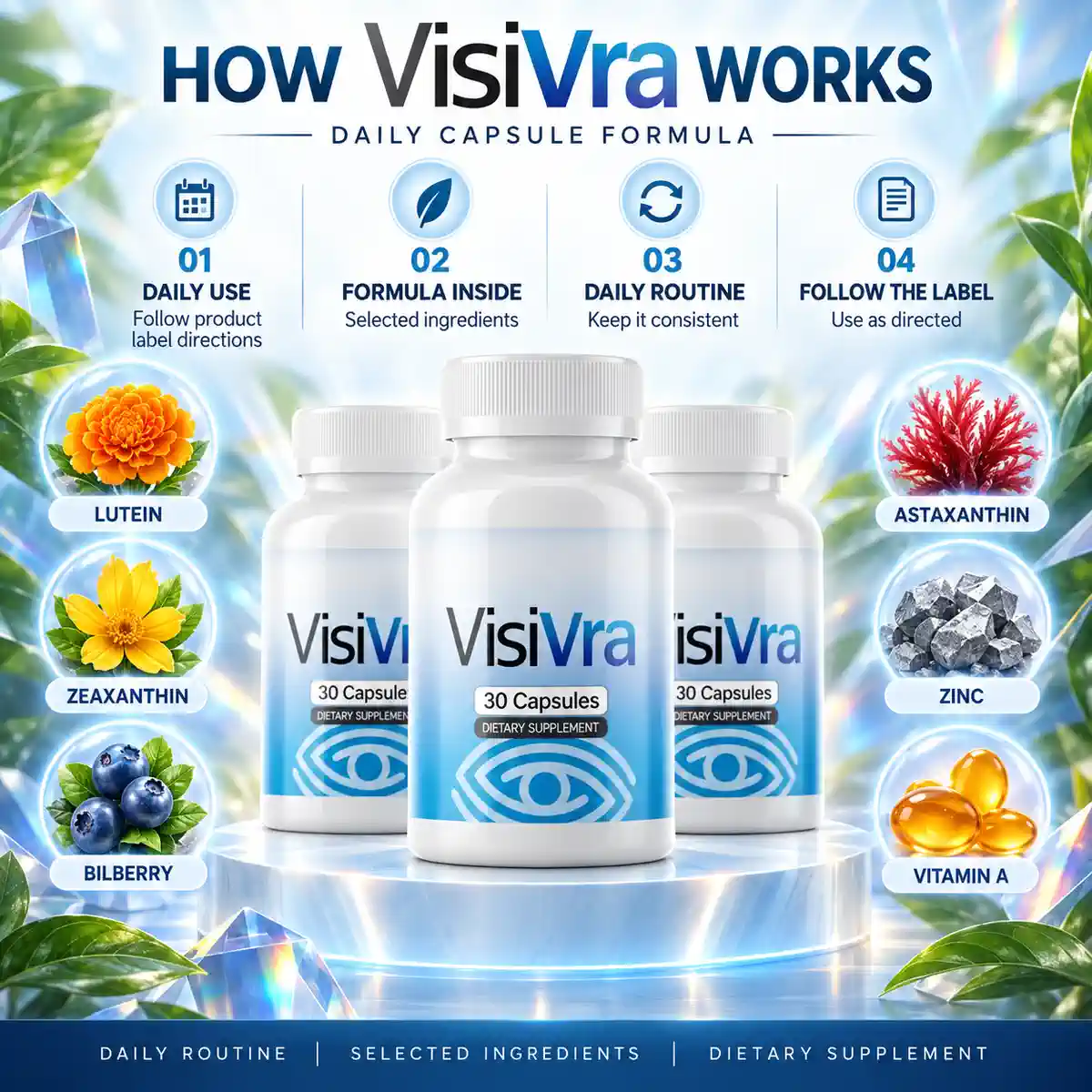
An eye supplement is not a drug and does not act like one. Nothing in this capsule changes the optics of the eye, alters a spectacle prescription or reverses damage that has already happened. What the six ingredients do is supply material the eye uses anyway, in a form the gut can absorb.
Three distinct routes are involved, and they belong to three different parts of the eye. Two of the six build a pigment layer in the macula. One is studied for the focusing muscle at the front. Two more feed the chemistry that resets a photoreceptor after light hits it.
Those three are set out in turn below, each with the human evidence behind it and the point at which that evidence stops. The fourth section is the one about the distance between a mechanism and a result.
How the carotenoids in Visivra build macular pigment
What a yellow pigment layer does, and how long it takes to build.
Lutein and zeaxanthin are yellow. Yellow pigment absorbs blue light, which is the short-wavelength end of the visible spectrum and the end that scatters most inside the eye. Layered in front of the photoreceptors, that pigment acts as an internal filter and a glare screen at the same time.
The layer is measurable. Macular pigment optical density is a real number an instrument can read, it rises when people eat or swallow more of these two carotenoids, and it rises slowly: a 2020 randomised trial tracked that rise alongside contrast sensitivity over months rather than weeks.
What the rise does for vision is the harder question, and the honest answer is that it depends who is being measured. CREST enriched macular pigment in people free of retinal disease and reported improved contrast sensitivity. A second trial looked at contrast sensitivity and lateral inhibition with the same class of supplementation.
1. The carotenoids arrive with a meal
Both are fat-soluble, so they cross the gut wall inside the fat from the food eaten with them. A controlled feeding study is the reason the how-to-use page says to take the capsule with a meal rather than with water.
2. They are carried in the bloodstream
Lipoproteins do the transport, which is why carotenoid levels in blood move over weeks and why a single dose tells you nothing.
3. They accumulate where the eye puts them
The macula takes up lutein and zeaxanthin selectively and holds them. That selectivity is the entire reason these two, out of hundreds of dietary carotenoids, are the ones on eye labels.
4. The pigment layer thickens, slowly
Published trials measuring the layer run twelve weeks at the short end and two years at the long end. That timescale is what the results timeline page is built around.
How bilberry and astaxanthin in Visivra relate to focusing
The front of the eye, the screen-work literature, and a different timescale.
Close work is muscular. The ciliary muscle contracts to let the lens round up for near vision and relaxes for distance, and a day spent at a fixed screen distance is a day that muscle spends held in one position. The tired, gritty, slow-to-refocus feeling after eight hours at a display is the everyday name for it.
That is the endpoint the bilberry trials chose. The twelve-week study at 240 mg a day looked directly at ciliary-muscle function, and the screen-worker study at 480 mg a day for eight weeks recruited people whose job is a display terminal. Anthocyanins are the compounds credited, and how many arrive per milligram depends on the extract's standardisation.
Astaxanthin sits in the same conversation from a different direction. The 2025 trial gave 4 mg a day for eighty-four days against digital eye strain, in children. A review of nutrition and digital eye strain puts the whole area in context, including how much of it rests on questionnaires rather than on instruments.
Macular pigment is a layer that accumulates. Ciliary-muscle comfort is a functional measurement that can move in either direction week to week with sleep, screen hours, air conditioning and an out-of-date spectacle prescription. Anyone judging this formula on how their eyes feel after a long working day is measuring the noisier of the two, which is why the timeline page asks for a written note rather than an impression.
How zinc and vitamin A in Visivra feed the visual cycle
Rhodopsin, the pigment epithelium, and the two ingredients that feed them.
A photoreceptor works by breaking a molecule. Light strikes rhodopsin, a vitamin A derivative bound to a protein, and changes its shape; that shape change is the signal. The molecule then has to be reset, and the resetting happens in the retinal pigment epithelium, the cell layer immediately behind the photoreceptors.
Zinc is a cofactor for enzymes in that recycling loop, and the retina holds more zinc per gram than almost any other tissue in the body. That is the mechanism behind its presence in eye formulas, and it is why the original AREDS trial built its arms around zinc rather than around the carotenoids.
Vitamin A is the raw material the loop consumes. Deficiency causes night blindness and eventually worse, which is one of the oldest established facts in ophthalmology. What does not follow is that more of it improves a healthy visual cycle, and the supplementation history of this particular vitamin is the reason the side effects page gives it a section of its own.
| The step | What it needs | Which of the six supplies it |
|---|---|---|
| Light strikes a photoreceptor | Rhodopsin, built on a vitamin A derivative | Vitamin A |
| The signal is sent | No supplement input at all | None |
| The spent molecule is recycled | Enzymes in the retinal pigment epithelium | Zinc, as a cofactor |
| Short-wavelength light is filtered on the way in | Yellow pigment in front of the photoreceptors | Lutein and zeaxanthin |
| The lens is reshaped for near work | Ciliary muscle function | Bilberry, in the twelve-week trials |
| Oxidative by-products are handled | Antioxidant capacity in the tissue | Astaxanthin, in laboratory work |
Every row is a description of normal eye function. None of them is a claim that this capsule improves the step beside it.
Read down that table and the shape of an eye formula becomes obvious. It is not one mechanism; it is five or six ordinary housekeeping processes, each of which happens to have a nutrient attached to it.
What Visivra can and cannot say about blue light
The one support on this pack where the evidence needs quoting carefully.
Defending the eyes from blue light exposure is one of the four supports printed on this pack, so it earns a plain account rather than a slogan. The physical part is settled: macular pigment absorbs short-wavelength light, and a thicker layer absorbs more of it. That is optics and it is not in dispute.
The clinical part is where care is needed. The 2023 Cochrane review of blue-light filtering lenses is the best evidence on the question and it is about spectacle lenses rather than capsules. Its conclusions are worth quoting accurately: probably little or no effect on visual acuity in the short term, uncertain effects on sleep, and no randomised evidence at all on macular health.
Those are three different findings and the third is the one usually mangled. An absence of randomised evidence is not a finding of no effect; it means the trial has not been run. This website states the support the pack prints, and states where the evidence for that general idea currently stands.
- Macular pigment absorbs short-wavelength light. That is physics and it is why the pigment is yellow.
- Lutein and zeaxanthin build that pigment over months, at the amounts the trials used.
- Whether a thicker layer changes anything a person notices at a screen is not settled, and the lens research is the closest thing to an answer.
- The pack's fourth support is printed here as the pack prints it, with that context attached rather than amplified.
Where the Visivra mechanism stops
Population, quantity and time: the three gaps between a mechanism and a promise.
Three honest limits sit between the mechanisms above and any promise about a person's vision, and naming them is what makes the rest of this page worth reading.
The first is population. AREDS2 enrolled people who already had intermediate age-related macular degeneration, or the advanced form in one eye, and measured progression to late disease. It is a secondary-prevention trial. The Cochrane review on prevention asks the separate question of whether supplements stop the disease starting in the first place, and the answer there is a different and much weaker one.
The second is quantity. A mechanism operates at a dose, and the trials above each ran at a stated one. The honest dosage section on the ingredients page sets those figures out in full.
The third is time. Every measurement in this field runs in months: eight weeks at the short end for the screen-worker study, five years for AREDS2. A week of capsules is not a test of any of it.
Vision that has changed is a reason for an eye examination, and an examination finds the things a capsule has nothing to do with: a changed prescription, a cataract forming, raised pressure, a retina that needs looking at. The National Eye Institute sets out what age-related macular degeneration is and how it is assessed. That appointment is not a formality before buying a supplement; it is the more useful of the two actions.
How Visivra works: common questions
How long does Visivra take to work?
The trials behind these ingredients ran eight weeks at the shortest and five years at the longest, and the macular pigment measurements move over months. The seller describes a typical wait of 3–6 weeks. The results timeline page sets out what to expect week by week.
Does Visivra improve eyesight?
It is a dietary supplement rather than a correction. Nothing in it changes the optics of the eye or replaces a spectacle prescription. The four supports the pack prints are about visual clarity, healthy retinal function, long-term eye wellness and defence against blue light, and those four are the ceiling on what this website says.
Does Visivra treat macular degeneration?
No. It is not a drug, it is not FDA-approved, and it is not intended to diagnose, treat, cure or prevent any disease. The AREDS and AREDS2 trials are described here for the amounts they used, and this bottle is not that formula.
Is the mechanism behind Visivra proven?
The mechanisms are well established as descriptions of normal eye function: macular pigment really does absorb blue light, zinc really is a cofactor in the visual cycle. What varies is how much a supplement changes any of it in a person, and that depends on the amount and on who is taking it.
Can Visivra help with screen fatigue?
Bilberry and astaxanthin are the two ingredients whose modern trials chose that endpoint, at 240–480 mg and 4 mg a day respectively. A review of the area covers how those studies are built, including how much of the outcome is self-reported.
Does Visivra work without changing anything else?
Light, screen hours, sleep and an up-to-date spectacle prescription all affect the same things this formula is sold for. A capsule taken alongside a screen habit that has never been adjusted is being asked to carry more than any capsule can.
Sources behind the Visivra mechanism
Every trial and review named above, in the order the routes appear.
- Age-Related Eye Disease Study 2 (AREDS2) Research Group. Lutein + zeaxanthin and omega-3 fatty acids for age-related macular degeneration: the Age-Related Eye Disease Study 2 (AREDS2) randomized clinical trial. JAMA. 2013;309(19):2005-15. PMID 23644932. https://pubmed.ncbi.nlm.nih.gov/23644932/
- Nolan JM, Power R, Stringham J, et al. Enrichment of macular pigment enhances contrast sensitivity in subjects free of retinal disease: Central Retinal Enrichment Supplementation Trials - report 1. Invest Ophthalmol Vis Sci. 2016;57(7):3429-39. PMID 27367585. https://pubmed.ncbi.nlm.nih.gov/27367585/
- Stringham JM, O'Brien KJ, Stringham NT. Contrast sensitivity and lateral inhibition are enhanced with macular carotenoid supplementation. Invest Ophthalmol Vis Sci. 2017;58(4):2291-2295. PMID 28431432. https://pubmed.ncbi.nlm.nih.gov/28431432/
- Machida N, Kosehira M, Kitaichi N. Clinical effects of dietary supplementation of lutein with high bio-accessibility on macular pigment optical density and contrast sensitivity: a randomized double-blind placebo-controlled parallel-group comparison trial. Nutrients. 2020;12(10):2966. PMID 32998324. https://pubmed.ncbi.nlm.nih.gov/32998324/
- White WS, Zhou Y, Crane A, et al. Modeling the dose effects of soybean oil in salad dressing on carotenoid and fat-soluble vitamin bioavailability in salad vegetables. Am J Clin Nutr. 2017;106(4):1041-1051. PMID 28814399. https://pubmed.ncbi.nlm.nih.gov/28814399/
- Kosehira M, Machida N, Kitaichi N. A 12-week-long intake of bilberry extract (Vaccinium myrtillus L.) improved objective findings of ciliary muscle contraction of the eye: a randomized, double-blind, placebo-controlled, parallel-group comparison trial. Nutrients. 2020;12(3):600. PMID 32106548. https://pubmed.ncbi.nlm.nih.gov/32106548/
- Ozawa Y, Kawashima M, Inoue S, et al. Bilberry extract supplementation for preventing eye fatigue in video display terminal workers. J Nutr Health Aging. 2015;19(5):548-54. PMID 25923485. https://pubmed.ncbi.nlm.nih.gov/25923485/
- Hecht KA, Marwah M, Wood V, et al. Astaxanthin (AstaReal) improved acute and chronic digital eye strain in children: a randomized double-blind placebo-controlled trial. Adv Ther. 2025;42(4):1811-1833. PMID 40014233. https://pubmed.ncbi.nlm.nih.gov/40014233/
- Lem DW, Gierhart DL, Davey PG. Can nutrition play a role in ameliorating digital eye strain? Nutrients. 2022;14(19):4005. PMID 36235656. https://pubmed.ncbi.nlm.nih.gov/36235656/
- Age-Related Eye Disease Study Research Group. A randomized, placebo-controlled, clinical trial of high-dose supplementation with vitamins C and E, beta carotene, and zinc for age-related macular degeneration and vision loss: AREDS report no. 8. Arch Ophthalmol. 2001;119(10):1417-36. PMID 11594942. https://pubmed.ncbi.nlm.nih.gov/11594942/
- Evans JR, Lawrenson JG. Antioxidant vitamin and mineral supplements for preventing age-related macular degeneration. Cochrane Database Syst Rev. 2017;7(7):CD000253. PMID 28756617. https://pubmed.ncbi.nlm.nih.gov/28756617/
- Singh S, Keller PR, Busija L, et al. Blue-light filtering spectacle lenses for visual performance, sleep, and macular health in adults. Cochrane Database Syst Rev. 2023;8(8):CD013244. PMID 37593770. https://pubmed.ncbi.nlm.nih.gov/37593770/
- National Eye Institute. Age-Related Macular Degeneration (AMD). National Institutes of Health. https://www.nei.nih.gov/learn-about-eye-health/eye-conditions-and-diseases/age-related-macular-degeneration
Order Visivra and give the mechanism time to matter
The pigment trials run in months, so the 60-day window is the shortest honest test. 30 capsules a bottle, from $49 a bottle.
Two bottles $158 · six bottles $294 · 60-day money-back guarantee
Order Visivra On The Official Website30 capsules a bottle · lot VIS-26/MY-3811 · ships from the U.S.