Visivra Official Website › Choosing A Vision Supplement
Choosing A Vision SupplementHow To Choose A Vision Supplement: Eight Checks
Eight questions you can put to any eye supplement label, in a shop or in a browser tab.
Each one has an answer that is good, an answer that is acceptable and an answer that is not. At the end, all eight are applied to the product this website sells, which passes three of them and fails four.
A checklist that is worth something precisely because the product beside it fails half of it.
Why eight checks rather than an opinion
Every check below can be answered from a bottle, by anybody.
A category with one dominant trial and a lot of marketing is one where a reader needs a method rather than a recommendation. Every product in this space quotes the same research; the differences that matter are in what each label prints.
So these eight are all label checks. Every one can be answered by looking at a bottle or a product page, none requires any scientific background, and none depends on trusting a review.
They are ordered by how much they tell you. The first two decide whether anything else on the label can be interpreted at all, and the last two are about the transaction rather than the formula.
The eight checks
Eight questions, each with what a good, an acceptable and an unacceptable answer looks like.
1. Does every active carry a printed amount?
Good: a Supplement Facts panel with a figure on every row. Acceptable: figures for the actives that matter and a clear other-ingredients line. Not acceptable: names alone, or a proprietary blend giving one combined weight. In this category the amount carries the evidence, because the trials are dose-specific.
2. Are the ingredients named individually?
Good: every ingredient named. Not acceptable: a blend name concealing the split. This is a separate question from check one, and a label can pass here and fail there.
3. Is the lutein and zeaxanthin pairing there, with form and source named?
Good: lutein 10 mg and zeaxanthin 2 mg, from named marigold extract, with the form stated. Acceptable: both present with amounts. Not acceptable: one without the other, or neither with a figure. Free lutein and lutein esters absorb differently.
4. Does the vitamin A row name its form, or is vitamin A absent?
Good: no vitamin A at all, which is what AREDS2 settled on. Acceptable: a named form with an amount. Not acceptable: the words Vitamin A with neither. CARET and ATBC are why this check is on the list.
5. Does copper travel with the zinc?
Good: zinc with copper, in something like the AREDS proportion. Acceptable: a modest zinc amount with no copper. Not acceptable: substantial zinc, no copper, and no amount printed for either. Forty milligrams a day is the adult upper intake from all sources.
6. Is there a serving size and a directions line?
Good: a serving size, a daily count and an instruction to take it with food, since the carotenoids need dietary fat. Not acceptable: a capsule count and nothing else, leaving the buyer to divide.
7. Is there a lot code, and a route to a certificate of analysis?
Good: a lot code on the bottle and a published certificate. Acceptable: a lot code and a desk that will supply the certificate on request. Not acceptable: neither, which makes a bottle untraceable to a production run.
8. Is there a refund window with a telephone number behind it?
Good: thirty days or more, claimed by telephone, with the terms written down including who pays return postage. Not acceptable: a satisfaction seal with no policy text anywhere.
The eight checks applied to Visivra
All eight, scored in public, on the website that sells the product.
| Check | Result | Why |
|---|---|---|
| 1. Every active carries a printed amount | Fail | Six actives are named and the figures sit with the seller. This is the check that makes the trial comparisons on the rest of this website impossible to complete. |
| 2. Ingredients named individually | Pass | No blend name appears anywhere on the pack. All six are named: lutein, zeaxanthin, bilberry extract, astaxanthin, zinc and vitamin A. |
| 3. Carotenoid pairing, with form and source | Partial | Lutein and zeaxanthin are both present and in the conventional order. Neither the form nor the source is named, and neither carries a figure. |
| 4. Vitamin A form named, or absent | Fail | The row reads Vitamin A. No form, no amount. It is the single most consequential gap on this label and the reason the side effects page leads with it. |
| 5. Copper travels with the zinc | Fail | Zinc is named; copper is not among the six. Whether that matters depends on the zinc amount, which is the check above. |
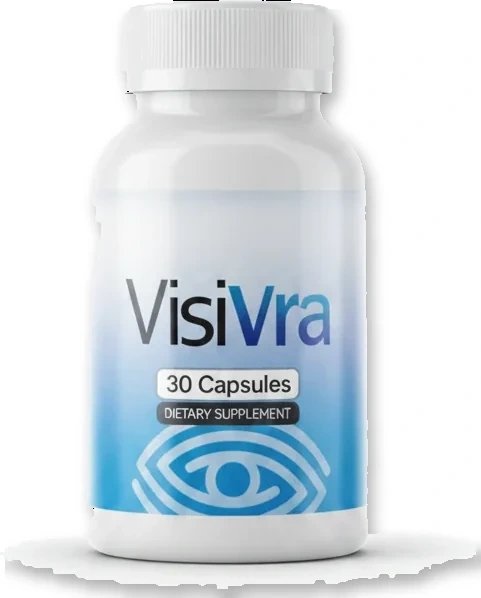
| 6. Serving size and directions | Fail | The front panel gives a capsule count of 30 and no serving line. One a day is arithmetic from the seller's own 60, 90 and 180-day pack labels. |
| 7. Lot code and a certificate route | Pass | Lot VIS-26/MY-3811 with certificate reference VIS-3811-26-MY, and an order desk that can be asked for the document itself. |
| 8. Refund window with a telephone behind it | Pass | 60 days from the date of purchase, claimed on +1 (323) 347-4522, with the terms written out including the buyer-pays-postage line. |
Three passes, one partial and four outright failures. The failures are the reason the passes are worth reading.
The four rows it fails, in detail
Four failures, each with what the check was testing and what the consequence is.
Check one fails at the root. The pack names six actives and the amounts sit with the seller. Three independent sources agree on the names and none of them carries a figure: the bottle's front panel, the vendor's ingredient artwork and the seller's own page. In a category where the defining trial is a specific formula at 10 mg and 2 mg, that single absence prevents every useful comparison a reader would want to make.
Check four fails with the most at stake. Vitamin A covers retinol and its esters on one hand and beta carotene on the other, and the two have different research histories at supplemental amounts. AREDS2 removed beta carotene after CARET and ATBC found more lung cancer among smokers in the supplemented arms. A row naming neither the form nor the amount cannot be assessed by the one group for whom the answer decides the purchase.
Check five fails in a way that depends on check one. AREDS gave zinc 80 mg with copper 2 mg deliberately, because sustained high zinc drives copper down over months. A label naming zinc without copper is a question rather than a verdict, and it is unanswerable while the zinc amount is unpublished.
Check six fails on a technicality that is not trivial. The front panel gives a capsule count and no serving line, so the once-daily routine on this website is arithmetic: thirty capsules against the seller's own 60, 90 and 180-day pack labels. The arithmetic is sound at every rung, and a printed line would have cost nothing.
That is four rows against one product, published on the website that sells it. The reason for doing so is the one given in the section above: a scorecard everything passes is not a scorecard, and a reader who cannot see this page fail is entitled to ignore the three rows it passes.
The three rows it passes, and what they are worth
Three passes, one partial, and how much each is actually worth.
Check two is a genuine pass and it is not nothing. A proprietary blend giving one combined weight for six ingredients is still the default in large parts of the supplement industry, and it is strictly worse than what this label does. Naming six actives individually means a reader knows exactly what to ask the seller about.
Check seven passes on the code and half-passes on the certificate. Lot VIS-26/MY-3811 is a real production reference and VIS-3811-26-MY is the filing number for the analysis behind it. What this desk holds is the number rather than the document, which it says plainly on the batch verification page rather than letting a reference in a serif font look like proof.
Check eight is the strongest row on the card. 60 days from the date of purchase, on every tier including the entry pack, claimed on a telephone number that a person answers. The terms are written out in full, including the one that costs a buyer money: return postage is theirs, with tracking requested.
The partial row is worth a sentence too. Lutein and zeaxanthin are both present and in the conventional pairing, which is the right pair to build an eye formula on. What is missing is the form and the source, which is the commonest omission on labels that are otherwise good.
Taking these checks to another label
Which checks most labels fail, and which two separate a seller from a landing page.
The scorecard is more useful on the next bottle than on this one. Most products in this category fail check three, because printing the form of a carotenoid is unusual even on good labels, and a great many fail check six by omitting the food instruction.
Check four is the one worth being strict about. A vitamin A row with no form named is a row that cannot be assessed, and the group for whom that matters most is defined precisely: anyone who smokes or used to. AREDS2's ten-year follow-up is the reference to have in mind.
Checks seven and eight are the ones that separate a real seller from a landing page. A lot code, a certificate route, a written refund policy and a telephone number that answers are all cheap for a legitimate operation and impossible to fake convincingly for one that is not.
- Turn the bottle over first. Checks one, two, three, five and six are all answered by the panel.
- Check four takes five seconds and rules out a product for one specific group of people.
- Check seven is on the base of the bottle.
- Check eight is on the seller's website, and its absence is more informative than any of the rest.
- A product failing four of eight is not automatically a bad product. It is a product whose buyer should ask the seller four specific questions before deciding.
What this scorecard cannot tell you
Disclosure is not quality, and the two questions no checklist answers.
Every check on this list is about disclosure rather than about quality, and that is a real limit worth stating before anyone scores a bottle and stops thinking.
A label that prints every amount can still print amounts too small to do anything. A label that names a form can still use a poor one. A certificate of analysis can be narrow, covering identity and contaminants and never touching potency. Disclosure is a lower bar than efficacy, and a great deal of this category fails even that.
Nor does a scorecard replace the two things that actually decide whether an eye supplement is worth taking: whether the person taking it needed it, and whether something else should have been looked at first. The National Eye Institute describes what an eye assessment involves, and it finds the things no capsule addresses.
Used honestly, though, eight questions that any reader can answer from a bottle are worth more than a star rating from somebody selling one. That is the whole claim this page makes for itself.
Sources for these eight checks
The trials and reference chapters each check is built on.
- Age-Related Eye Disease Study 2 (AREDS2) Research Group. Lutein + zeaxanthin and omega-3 fatty acids for age-related macular degeneration: the Age-Related Eye Disease Study 2 (AREDS2) randomized clinical trial. JAMA. 2013;309(19):2005-15. PMID 23644932. https://pubmed.ncbi.nlm.nih.gov/23644932/
- Age-Related Eye Disease Study Research Group. A randomized, placebo-controlled, clinical trial of high-dose supplementation with vitamins C and E, beta carotene, and zinc for age-related macular degeneration and vision loss: AREDS report no. 8. Arch Ophthalmol. 2001;119(10):1417-36. PMID 11594942. https://pubmed.ncbi.nlm.nih.gov/11594942/
- Chew EY, Clemons TE, Agron E, et al. Long-term outcomes of adding lutein/zeaxanthin and omega-3 fatty acids to the AREDS supplements on age-related macular degeneration progression: AREDS2 report 28. JAMA Ophthalmol. 2022;140(7):692-698. PMID 35653117. https://pubmed.ncbi.nlm.nih.gov/35653117/
- Olmedilla-Alonso B, Granado-Lorencio F, Castro-Feito J, et al. Bioavailability of lutein from marigold flowers (free vs. ester forms): a randomised cross-over study to assess serum response and visual contrast threshold in adults. Nutrients. 2024;16(10):1415. PMID 38794653. https://pubmed.ncbi.nlm.nih.gov/38794653/
- Zhang Y, Hao J, Cao K, et al. Macular pigment optical density responses to different levels of zeaxanthin in patients with high myopia. Graefes Arch Clin Exp Ophthalmol. 2022;260(7):2329-2337. PMID 35044504. https://pubmed.ncbi.nlm.nih.gov/35044504/
- Canter PH, Ernst E. Anthocyanosides of Vaccinium myrtillus (bilberry) for night vision - a systematic review of placebo-controlled trials. Surv Ophthalmol. 2004;49(1):38-50. PMID 14711439. https://pubmed.ncbi.nlm.nih.gov/14711439/
- Hecht KA, Marwah M, Wood V, et al. Astaxanthin (AstaReal) improved acute and chronic digital eye strain in children: a randomized double-blind placebo-controlled trial. Adv Ther. 2025;42(4):1811-1833. PMID 40014233. https://pubmed.ncbi.nlm.nih.gov/40014233/
- Institute of Medicine (US) Panel on Micronutrients. Zinc. In: Dietary Reference Intakes for Vitamin A, Vitamin K, Arsenic, Boron, Chromium, Copper, Iodine, Iron, Manganese, Molybdenum, Nickel, Silicon, Vanadium, and Zinc. Washington (DC): National Academies Press; 2001. https://www.ncbi.nlm.nih.gov/books/NBK222317/
- Amisha F, Saluja P, Gautam N, et al. Acquired hyperzincaemia due to zinc-laden denture adhesives leading to hypocupraemia as a cause of neutropenia. Eur J Case Rep Intern Med. 2021;8(11):002983. PMID 34912740. https://pubmed.ncbi.nlm.nih.gov/34912740/
- Omenn GS, Goodman GE, Thornquist MD, et al. Effects of a combination of beta carotene and vitamin A on lung cancer and cardiovascular disease. N Engl J Med. 1996;334(18):1150-5. PMID 8602180. https://pubmed.ncbi.nlm.nih.gov/8602180/
- Alpha-Tocopherol, Beta Carotene Cancer Prevention Study Group. The effect of vitamin E and beta carotene on the incidence of lung cancer and other cancers in male smokers. N Engl J Med. 1994;330(15):1029-35. PMID 8127329. https://pubmed.ncbi.nlm.nih.gov/8127329/
- Institute of Medicine (US) Panel on Micronutrients. Vitamin A. In: Dietary Reference Intakes for Vitamin A, Vitamin K, Arsenic, Boron, Chromium, Copper, Iodine, Iron, Manganese, Molybdenum, Nickel, Silicon, Vanadium, and Zinc. Washington (DC): National Academies Press; 2001. https://www.ncbi.nlm.nih.gov/books/NBK222318/
- MedlinePlus Medical Encyclopedia. Vitamin A. U.S. National Library of Medicine. https://medlineplus.gov/ency/article/002400.htm
- White WS, Zhou Y, Crane A, et al. Modeling the dose effects of soybean oil in salad dressing on carotenoid and fat-soluble vitamin bioavailability in salad vegetables. Am J Clin Nutr. 2017;106(4):1041-1051. PMID 28814399. https://pubmed.ncbi.nlm.nih.gov/28814399/
- National Eye Institute. Age-Related Macular Degeneration (AMD). National Institutes of Health. https://www.nei.nih.gov/learn-about-eye-health/eye-conditions-and-diseases/age-related-macular-degeneration
- Singh S, Keller PR, Busija L, et al. Blue-light filtering spectacle lenses for visual performance, sleep, and macular health in adults. Cochrane Database Syst Rev. 2023;8(8):CD013244. PMID 37593770. https://pubmed.ncbi.nlm.nih.gov/37593770/
Order Visivra with four failures already in front of you
Three passes, one partial, four failures, and a 60-day window that lets a buyer test what a scorecard cannot measure.
Two bottles $158 · six bottles $294 · 60-day money-back guarantee
Order Visivra On The Official Website30 capsules a bottle · lot VIS-26/MY-3811 · ships from the U.S.