Lutein And Zeaxanthin In Healthy Adults Under 50: What The Trials Measured
Almost every eye-supplement label leans on trials in people in their sixties and seventies who already had, or were at risk of, macular degeneration. There is a second, smaller body of research in healthy young and middle-aged adults. It asks a different question, measures different things, and never claims to prevent a disease. This article is about that second literature, and about where it stops.
- In healthy adults, randomised trials of lutein and zeaxanthin mostly measure macular pigment density and simple tests of vision under bright light, glare and low contrast.
- Pigment density rises in most of them, over months rather than days, and a large meta-analysis found the rise depends on how much lutein and zeaxanthin was taken.
- Some trials also report better contrast sensitivity, faster recovery from a bright flash, or better tear-film measures in heavy screen users. Self-reported eye strain and sleep have not moved reliably.
- None of these trials tested whether anything prevents eye disease. They ran for weeks to a year, in people with healthy retinas.
- The amount decides what any of this applies to, and the Visivra label prints no amount.
Two literatures under one label
When a bottle names lutein and zeaxanthin, a reader tends to assume the research behind those names is one thing. It is two.
The first is the disease literature. Its best-known trial, AREDS2, enrolled older people who already had intermediate macular degeneration or advanced disease in one eye, and measured whether the disease progressed. That is covered in full in the article on what AREDS2 tested, and it will not be re-run here beyond that one line.
The second is the healthy-adult literature. These are trials in people whose retinas were normal at the start: students in their early twenties, office workers, professional drivers, volunteers up to about sixty-five. Nobody in them was being treated for anything. The researchers were not asking whether a capsule prevents blindness. They were asking something smaller and more testable: does taking these two carotenoids change how much of them sits in the macula, and does that change anything you can measure about how a healthy person sees?
Those are legitimate questions, and the answers are more interesting than the marketing version. They are also a lot narrower.
What the trials actually measured
Before the results, it helps to know what the words mean, because these trials use instruments that do not appear on a label.
Macular pigment optical density
Macular pigment is the yellow layer at the centre of the retina, built from lutein, zeaxanthin and a third carotenoid, meso-zeaxanthin. Macular pigment optical density, usually shortened to MPOD, is a number describing how much light that layer absorbs. Most of the trials below measured it with heterochromatic flicker photometry, in which a person adjusts a flickering light until the flicker disappears, or with a photographic method based on autofluorescence. The first depends on the person doing the test being a careful and consistent observer, which is one reason a single measurement is noisy.
Serum levels
Blood levels of lutein and zeaxanthin are the simplest check that a supplement was actually absorbed. They rise within weeks. They are evidence of uptake, not of any benefit.
Tests of visual performance
- Contrast sensitivity is the ability to tell a faint grey pattern from a slightly different grey background. It is measured on a chart or screen at several pattern sizes, called spatial frequencies.
- Photostress recovery is how long it takes to see a small target again after a bright flash of light. Think of the second or two after an oncoming headlight.
- Disability glare is how much light shining around a target makes it impossible to see, measured by turning up a ring of light until a target disappears.
- Chromatic contrast is the same idea using coloured targets, in these trials a yellow pattern against a blue background.
Notice what is absent from that list: any measure of disease. That is not a criticism of the trials. It is a description of what they can support.
Result one: the pigment goes up
The most consistent finding in healthy adults is the simplest. Give people lutein and zeaxanthin for a few months, and the density of their macular pigment rises.
The best summary is a 2021 systematic review and meta-analysis in Advances in Nutrition (Wilson and colleagues). It pooled 46 studies with 3,189 adults with healthy eyes, mean age 43. The finding that matters most is the pattern by dose. Among studies giving under 5 mg a day of lutein and zeaxanthin, mostly dietary interventions over three to six months, the pooled change in MPOD was not statistically significant. Among studies giving 5 mg to under 20 mg a day the pooled increase was 0.04 units, and among studies giving 20 mg or more a day for three to twelve months it was 0.11 units. The authors concluded that MPOD rises with intake, particularly at higher doses, and that the effect of amounts under 5 mg a day, or from diet alone, is less clear.
A dose-response trial made the same point in a single experiment. Bone and Landrum gave 87 people 5, 10 or 20 mg of lutein as esters, or placebo, for 140 days. Serum lutein rose in a straight line with dose, and so, on average, did MPOD. They did not detect a significant influence of age on either.
Two things follow, and both matter for anyone reading a label. First, the effect is real enough to measure, which is more than can be said for several other eye-supplement claims. Second, it depends on the amount. A study that used 6 mg and a study that used 20 mg are not the same experiment, and a bottle that does not say which one it resembles cannot borrow the result of either.
The healthy-adult trials side by side
Here are the main randomised and controlled studies in healthy people, in the words of their own abstracts. The amounts are what each study gave, in every case a research supplement, and none is a Visivra figure.
| Study | Who took part | What was given, and for how long | What it reported |
|---|---|---|---|
| Hammond 2014 | 115 young, healthy adults | Lutein 10 mg and zeaxanthin 2 mg daily against placebo, one year | MPOD, serum levels, chromatic contrast and photostress recovery improved against placebo. Glare disability tracked pigment density but did not rise significantly in the treated group. |
| Stringham 2016 | 59 healthy volunteers, mean age 21.7 | Two doses of a lutein, zeaxanthin and meso-zeaxanthin combination, or placebo, 12 months | MPOD, photostress recovery and disability glare thresholds all improved against placebo at 6 and 12 months. |
| Ma 2009 | 37 healthy adults aged 22 to 30 with long-term computer display exposure | Lutein 6 mg, lutein 12 mg or placebo, 12 weeks | Serum lutein rose. Contrast sensitivity improved, reaching significance at most visual angles in the 12 mg group. No significant change in glare sensitivity or acuity. |
| Yao 2013 | 120 healthy drivers | Lutein 20 mg daily against placebo, one year | MPOD rose. Contrast and glare sensitivity improved, especially in dim light, and drivers scored better on the driving items of a vision questionnaire. Acuity showed a trend but no significant change. |
| Kvansakul 2006 | 34 subjects from a supplementation trial | Lutein, zeaxanthin, both, or placebo, 6 months | Contrast acuity thresholds in dim-to-moderate light improved significantly in the lutein group, but did not correlate with pigment density. |
| Bovier 2015 | 69 young healthy subjects | Placebo or one of two lutein-and-zeaxanthin supplements, 4 months | MPOD and a measure of visual processing speed both improved with supplementation and did not change on placebo. |
| Nolan 2016 (CREST) | 105 people free of retinal disease, with low retinal carotenoid levels | Lutein 10 mg, zeaxanthin 2 mg and meso-zeaxanthin 10 mg, or placebo, 12 months | Contrast sensitivity improved at 6 and 1.2 cycles per degree against placebo, in step with the rise in retinal carotenoids. |
Seven trials, three to twelve months, thirty-odd to a little over a hundred people each. Every one measured a function of vision under specific test conditions.
Two details in that table are easy to miss. In Kvansakul's trial the visual improvement appeared without a matching correlation with pigment density, so the mechanism is not settled even where the result is. And several of these products contained meso-zeaxanthin as well, a third carotenoid that a lutein-and-zeaxanthin label does not mention, so the trials do not all describe the same formula.
Glare, bright flashes and low contrast
The trials keep returning to three situations: light shining in your face, a sudden bright flash, and dim or low-contrast scenes. It is worth asking why.
Macular pigment is yellow, and yellow absorbs short-wavelength light. The idea is that a denser pigment layer sits in front of the photoreceptors as a kind of built-in filter, reducing scattered blue light and glare and sharpening contrast. That would predict exactly these three outcomes. The optics are not in dispute, and the blue-light article covers the line between the physics and the marketing claim.
The stronger evidence for the link between pigment and glare performance is actually observational. Stringham and colleagues tested 26 people under free-viewing conditions and found that those with denser pigment recovered faster from photostress, had lower disability-glare thresholds and reported less visual discomfort. A 2021 meta-analysis by Johnson and colleagues pooled 22 publications in adults with healthy eyes and found significant correlations between MPOD and contrast sensitivity, photostress recovery and glare disability.
Correlations like those show that people with more pigment perform better. They do not show that raising pigment with a capsule produces the same benefit in a person who starts low, which is the claim a supplement label wants to make. That question needs a randomised trial, which is what the table above contains. The results there are encouraging and uneven: photostress recovery improved in the Hammond and Stringham trials, glare disability improved in Stringham's but not significantly in Hammond's, and contrast sensitivity improved in several. Uneven is the honest word.
Heavy screen users
Many people who buy an eye supplement are thinking of screens rather than the macula, and one recent trial asked that question directly. The Lopresti and Smith trial was published in Frontiers in Nutrition in 2025. It randomised 70 adults aged 18 to 65 who used electronic screens for more than six hours a day to a lutein and zeaxanthin product, 10 mg and 2 mg, or placebo, for six months.
The results split cleanly, and the split is the useful part. Compared with placebo, the supplement was associated with greater improvement in the Schirmer tear test, in photostress recovery time and in tear film break-up time, which are objective examination findings related to dry eye and visual health. But there were no between-group differences in the self-reported measures of visual fatigue, computer vision symptoms, sleep quality or attention, and none in contrast sensitivity. No serious adverse reactions and no clinically significant changes in safety blood tests were reported.
That is worth pausing on. A person taking a capsule for tired screen eyes is hoping to feel better. In the one recent trial built around exactly that person, the examination measures moved and the feelings did not, at least not more than on placebo. It does not mean nothing helps; it means that the honest expectation for symptoms is modest. The timeline article covers how to judge this for yourself, and the free changes that do move screen symptoms.
Stress, mood and sleep
One healthy-adult trial went somewhere unexpected. Stringham, Holmes and Stringham randomised 59 young, healthy people to placebo, 13 mg or 27 mg a day of the three macular carotenoids for twelve months. Against placebo, supplementation improved psychological stress ratings, serum cortisol and measures of emotional and physical health at six months, with the effects maintained or improved at twelve. At baseline, higher MPOD also correlated with lower anxiety scores.
It is a single, small, interesting trial, and the authors themselves say that whether the effect is systemic or in the brain is a question for further study. The screen-user trial above, which measured sleep quality and attention by questionnaire, found no group difference. Treat this as an open question rather than a benefit. It is included here because it shows how broad the healthy-adult literature has become, and how little of it has been repeated.
What none of these trials tested
Here is the part that gets lost when a result is compressed into a label. The trials above cannot tell you any of the following, and it is fair to say so plainly.
- Whether it prevents macular degeneration. That disease develops over decades. These trials ran for months to a year, in people with healthy retinas, and none had a disease endpoint.
- Whether it protects against blue light from screens. Some trials recruited heavy screen users, but none measured retinal damage from screens, and the best clinical review of blue-light filtering, in spectacle lenses rather than capsules, found no randomised evidence on macular health, as the blue-light article sets out.
- Whether the benefit lasts. Trials stop when they stop. What happens to pigment density and performance afterwards is a separate question.
- Whether it helps someone who already has good pigment. The CREST trial deliberately recruited people with low retinal carotenoid levels. A person who eats plenty of leafy greens and eggs may start further along, and the trials report group averages rather than promises to an individual.
- Whether the result applies to a different formula. Trials used specific products, at specific amounts, sometimes with a third carotenoid. A different capsule is a different experiment.
Add the plain limits of size. The largest of these trials had 120 people and four of the seven had fewer than 70. Who paid for each trial varies, and it is worth checking in each paper before leaning on a single result. The 2016 review by Bernstein and colleagues is a good place to read the wider science on the three macular carotenoids if you want to go further.
Reading this against a label with no amounts
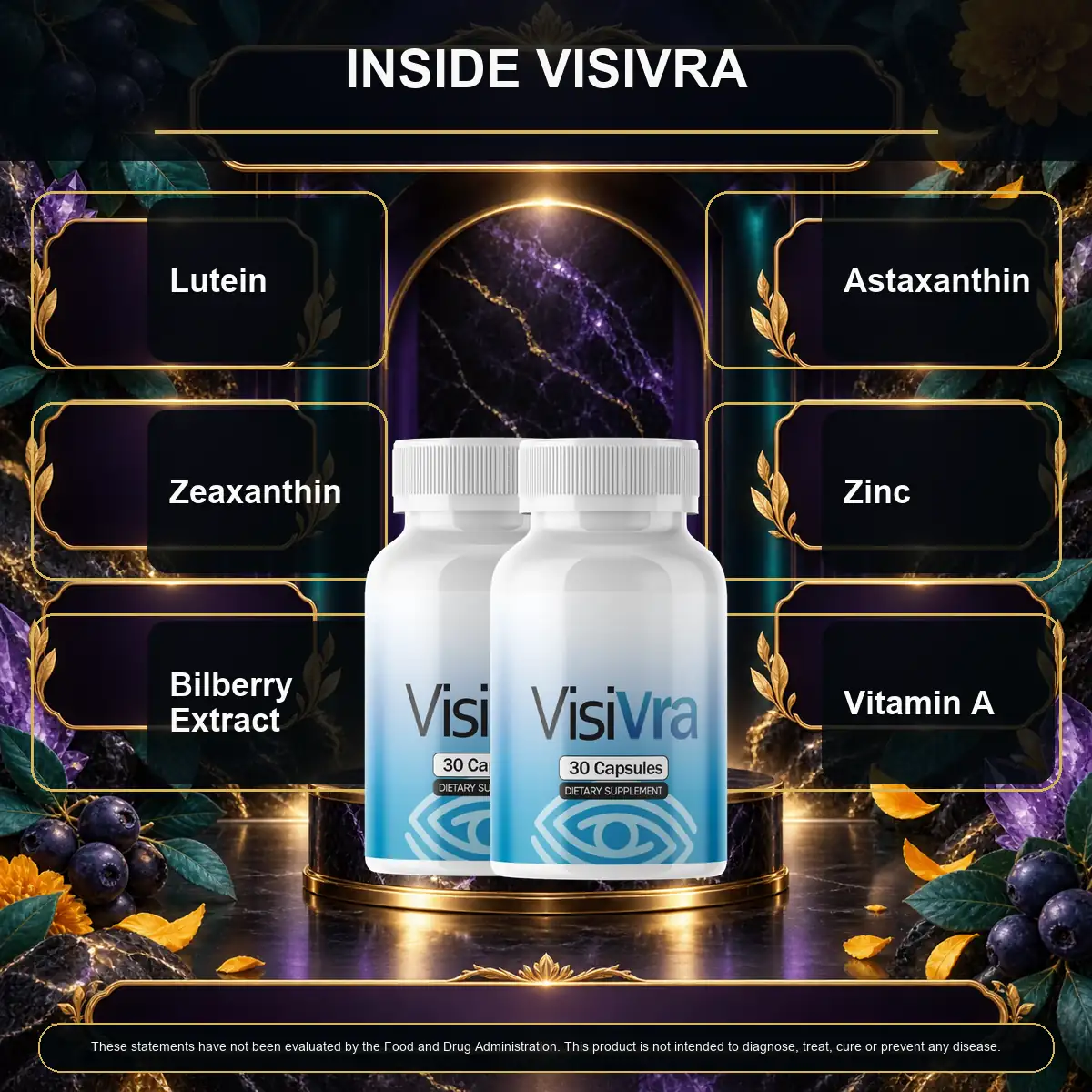
The Visivra front panel prints the wordmark, 30 capsules, the words dietary supplement and an eye glyph. The vendor's ingredient artwork names six actives in order: lutein, zeaxanthin, bilberry extract, astaxanthin, zinc and vitamin A. The stated supports are visual clarity, healthy retinal function, long-term eye wellness and help defending the eyes from blue-light exposure. No amount is printed for any of the six, and there is no serving size on the printed face.
Against the evidence above, that has three practical consequences.
- The trial results are conditional on amount. The meta-analysis found no significant pigment change below 5 mg a day, and it was mostly diet in that range. A capsule with an unstated quantity of lutein could sit anywhere on that curve, so the improvement in the table cannot be assumed to transfer.
- The realistic outcomes are the modest ones. If the healthy-adult trials are a fair guide, the things worth watching for over several months are contrast in dim light, recovery from glare and bright flashes, and, in heavy screen users, objective tear-film measures. Persistent improvement in how tired your eyes feel is not something the best recent trial found.
- Nothing here is about disease. A capsule that has helped a healthy person's glare recovery has not been shown to protect a retina. Regular eye examinations, not smoking and a diet rich in leafy vegetables are the established parts of that story, and a supplement sits beside them rather than in place of them.
If you take lutein and zeaxanthin for the reasons these trials examined, pick one thing to notice before you start: how quickly you recover after headlights at night, or how you read low-contrast print in dim light. Write down how it looks now, and compare at the three-month and six-month marks. The trials suggest months, not weeks, and a single honest observation beats a vague sense.
The ingredients page sets out what each of the six names has been studied for, and the who-it-is-for page covers the people who should ask a clinician first.
Read the evidence first, then decide about Visivra
Six named actives, 30 capsules a bottle, and a label that leaves the amounts for you to ask about.
Order VisivraReferences
- Wilson LM, Tharmarajah S, Jia Y, Semba RD, Schaumberg DA, Robinson KA. The effect of lutein/zeaxanthin intake on human macular pigment optical density: a systematic review and meta-analysis. Adv Nutr. 2021;12(6):2244-2254. PMID 34157098. https://pubmed.ncbi.nlm.nih.gov/34157098/
- Bone RA, Landrum JT. Dose-dependent response of serum lutein and macular pigment optical density to supplementation with lutein esters. Arch Biochem Biophys. 2010;504(1):50-5. PMID 20599660. https://pubmed.ncbi.nlm.nih.gov/20599660/
- Hammond BR, Fletcher LM, Roos F, Wittwer J, Schalch W. A double-blind, placebo-controlled study on the effects of lutein and zeaxanthin on photostress recovery, glare disability, and chromatic contrast. Invest Ophthalmol Vis Sci. 2014;55(12):8583-9. PMID 25468896. https://pubmed.ncbi.nlm.nih.gov/25468896/
- Stringham JM, O'Brien KJ, Stringham NT. Macular carotenoid supplementation improves disability glare performance and dynamics of photostress recovery. Eye Vis (Lond). 2016;3:30. PMID 27857944. https://pubmed.ncbi.nlm.nih.gov/27857944/
- Ma L, Lin XM, Zou ZY, Xu XR, Li Y, Xu R. A 12-week lutein supplementation improves visual function in Chinese people with long-term computer display light exposure. Br J Nutr. 2009;102(2):186-90. PMID 19586568. https://pubmed.ncbi.nlm.nih.gov/19586568/
- Yao Y, Qiu QH, Wu XW, Cai ZY, Xu S, Liang XQ. Lutein supplementation improves visual performance in Chinese drivers: 1-year randomized, double-blind, placebo-controlled study. Nutrition. 2013;29(7-8):958-64. PMID 23360692. https://pubmed.ncbi.nlm.nih.gov/23360692/
- Kvansakul J, Rodriguez-Carmona M, Edgar DF, et al. Supplementation with the carotenoids lutein or zeaxanthin improves human visual performance. Ophthalmic Physiol Opt. 2006;26(4):362-71. PMID 16792735. https://pubmed.ncbi.nlm.nih.gov/16792735/
- Bovier ER, Hammond BR. A randomized placebo-controlled study on the effects of lutein and zeaxanthin on visual processing speed in young healthy subjects. Arch Biochem Biophys. 2015;572:54-57. PMID 25483230. https://pubmed.ncbi.nlm.nih.gov/25483230/
- Nolan JM, Power R, Stringham J, et al. Enrichment of macular pigment enhances contrast sensitivity in subjects free of retinal disease: Central Retinal Enrichment Supplementation Trials - Report 1. Invest Ophthalmol Vis Sci. 2016;57(7):3429-39. PMID 27367585. https://pubmed.ncbi.nlm.nih.gov/27367585/
- Stringham JM, Garcia PV, Smith PA, McLin LN, Foutch BK. Macular pigment and visual performance in glare: benefits for photostress recovery, disability glare, and visual discomfort. Invest Ophthalmol Vis Sci. 2011;52(10):7406-15. PMID 21296819. https://pubmed.ncbi.nlm.nih.gov/21296819/
- Johnson EJ, Avendano EE, Mohn ES, Raman G. The association between macular pigment optical density and visual function outcomes: a systematic review and meta-analysis. Eye (Lond). 2021;35(6):1620-1628. PMID 32792595. https://pubmed.ncbi.nlm.nih.gov/32792595/
- Lopresti AL, Smith SJ. The effects of lutein/zeaxanthin (Lute-gen) on eye health, eye strain, sleep quality, and attention in high electronic screen users: a randomized, double-blind, placebo-controlled study. Front Nutr. 2025;12:1522302. PMID 39963662. https://pubmed.ncbi.nlm.nih.gov/39963662/
- Stringham NT, Holmes PV, Stringham JM. Supplementation with macular carotenoids reduces psychological stress, serum cortisol, and sub-optimal symptoms of physical and emotional health in young adults. Nutr Neurosci. 2018;21(4):286-296. PMID 28198205. https://pubmed.ncbi.nlm.nih.gov/28198205/
- Bernstein PS, Li B, Vachali PP, et al. Lutein, zeaxanthin, and meso-zeaxanthin: the basic and clinical science underlying carotenoid-based nutritional interventions against ocular disease. Prog Retin Eye Res. 2016;50:34-66. PMID 26541886. https://pubmed.ncbi.nlm.nih.gov/26541886/