Visivra Official Website › Blog › Screens and Night Drives: What an Eye Supplement Can Realistically Do
Screens and Night Drives: What an Eye Supplement Can Realistically Do
Two kinds of buyers find their way to eye supplements. One spends eight hours a day at a display and feels it behind the eyes by evening. The other drives at night and winces at oncoming headlights. Both want to know the same thing. Will a capsule help? This page sorts what the studies measured from what the marketing says, and puts the free fixes next to the paid one.
A capsule may support screen comfort and glare handling slowly, but the evidence is thin and was gathered on single ingredients at stated amounts, not on Visivra. Blink rate, screen hours, air conditioning and an up-to-date prescription often matter more. Sudden changes need an eye doctor, not a supplement.
- Bilberry trials: 240 mg a day for twelve weeks (ciliary-muscle function) and 480 mg a day for eight weeks in screen workers.
- Astaxanthin trial: 4 mg a day for 84 days against digital eye strain, in children.
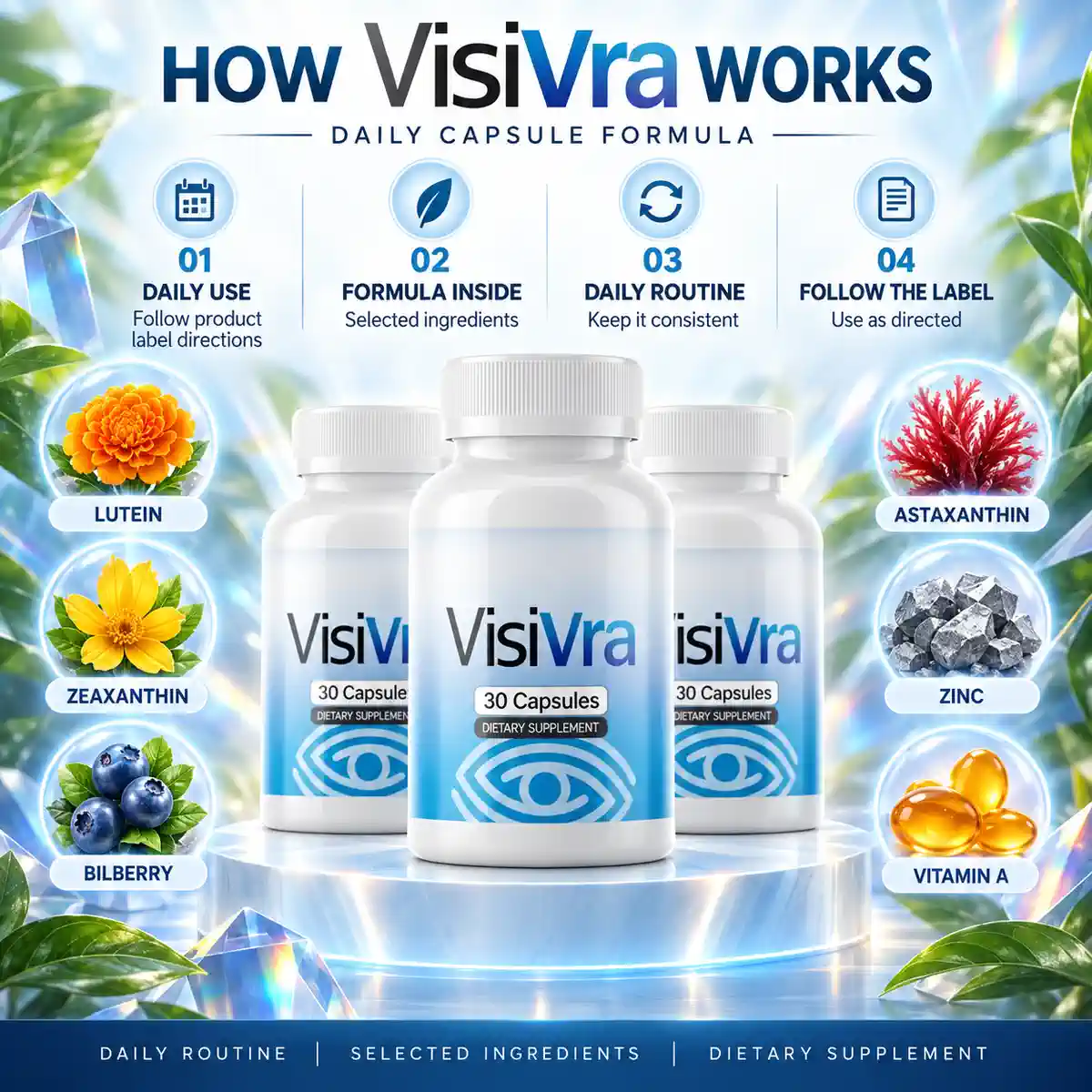
- Visivra names bilberry extract and astaxanthin but prints no amount for either.
- No claim about night vision appears on the pack or this website. The old bilberry night-vision story did not survive testing.
- One of the four printed supports is help defending the eyes from blue light exposure. The clinical question is less settled than the physics.
- Changed vision is a reason for an eye examination, not a supplement.
Can an eye supplement help with digital eye strain?
Maybe a little, and slowly. Digital eye strain is the tired, gritty, slow-to-refocus feeling after a long day at a fixed distance. The muscle at the front of the eye that reshapes the lens for near work spends the day held in one position. That muscle is what the bilberry trials looked at.
The honest summary of the field is modest. A review of nutrition and digital eye strain puts the whole area in context, including how much of it rests on questionnaires rather than instruments. People report how their eyes feel, and how eyes feel moves with sleep, screen hours and the air in the room.
So a capsule that helped one trial group is not a promise for you. That is not cynicism. It is how the evidence reads.
What did the bilberry and astaxanthin trials actually measure?
| Trial | Amount a day | Length | Who took part | What was measured |
|---|---|---|---|---|
| Ciliary-muscle trial | 240 mg bilberry extract | 12 weeks | Adults, randomised and placebo-controlled | Ciliary-muscle function |
| Screen-worker study | 480 mg bilberry extract | 8 weeks | Display-terminal workers | Eye fatigue |
| 2025 astaxanthin trial | 4 mg astaxanthin | 84 days | Children | Digital eye strain |
These are the amounts the studies used. Visivra prints no amount for either ingredient, so none of these results transfers to the capsule.
Two cautions deserve a plain sentence each. First, bilberry extracts are standardised to an anthocyanin percentage, and that percentage matters more than the weight beside it. Second, astaxanthin does not build up in the macular pigment the way lutein does. The research on it points at the focusing apparatus and at strain. A review of astaxanthin notes that much of the wider work is laboratory research on oxidation rather than outcomes in people.
Fix the free things first, then decide
If you want to add a capsule to a tidy routine, the official checkout shows today's price and the 60-day guarantee.
Two bottles $158 · three bottles $207 · six bottles $294 · 60-day money-back guarantee
See today’s price and guaranteePrices as read on 18 September 2026; the checkout shows the current price. Disclosure: Myvisivra is paid when an order is placed through the seller’s checkout.
What about blue light?
Part of the story is solid physics. Macular pigment is yellow, yellow absorbs blue, and a thicker layer absorbs more. That is why the pigment is there. Lutein and zeaxanthin build it, slowly, at the amounts the trials used.
The clinical part is not settled. The 2023 Cochrane review of blue-light filtering lenses found probably little or no difference in visual acuity in the short term, an uncertain effect on sleep, and no randomised evidence on macular health. That review is about lenses, not capsules. We quote it because it is the nearest good evidence, not because it settles the capsule question.
Absence of randomised evidence is not a finding of no effect. It means the trial has not been run. The pack prints a support about defending the eyes from blue light exposure. We print it as the pack does, with this context attached.
Does a vision supplement help with night driving?
We make no claim of that kind, and neither does the pack. The famous story that bilberry sharpened night vision for wartime pilots did not survive testing. A systematic review went looking in placebo-controlled trials and found the positive results sat in the uncontrolled ones.
What the carotenoid trials chose as endpoints were contrast sensitivity and glare recovery. Both matter to drivers. Both are slow measures, not overnight ones. The CREST trial ran twelve months before it measured its result, and a contrast-sensitivity trial looked at the same idea with the same approach.
If glare at night has been getting worse over months, cataract is the commonest cause, and that is a matter for an eye examination. A capsule is not an answer to it.
What helps faster than a capsule?
A short list of unglamorous things moves the same symptoms faster, and costs nothing.
- Cut or break up screen hours, and log the number so you know what changed.
- Blink more. Dryness at a screen is strongly driven by blink rate and air conditioning, both of which respond faster to a habit change than to any capsule.
- Get your spectacle prescription checked. An out-of-date one causes blur and headaches that no capsule will touch.
- Sleep. Two or more short nights in a week will swamp any subtle effect.
- Book the eye exam if it has been more than two years.
Do these first. If you then want to add a capsule, you will be able to tell the difference, because you will have fewer other things moving at once.
Are natural eye health supplements better?
Natural is the weakest word on a supplement. There is no agreed definition of natural for a supplement, and no certifier stands behind the natural ingredients mark on this pack. We audit it on the testing and quality page and rate it as marketing language.
What you can check is concrete. The source of each ingredient, the form, the amount and the lot. Marigold lutein, algal astaxanthin and bilberry all have cheaper look-alikes in the supply chain. A certificate of analysis would address identity and potency. Ask the order desk what the certificate for lot VIS-26/MY-3811 reports. Our bottle check shows how.
How could you test it at your own desk?
Before the first capsule, write down your usual screen hours, your end-of-day comfort from one to five, and the glare recovery time on your usual night route in seconds. Take one capsule a day with a meal. Repeat the same three at day 30 and day 60 and log screen hours beside each.
The seller describes a typical wait of 3 to 6 weeks, and the shortest published trial on these ingredients ran eight weeks. Do not judge it in week one. The full method is in our results guide.
Which sources sit behind this article?
Every study named in this article is one of the sources already cited across this website. Each link opens the public record. The studies tested single ingredients at stated amounts. None of them tested the finished Visivra capsule.
- A review of nutrition and digital eye strain. https://pubmed.ncbi.nlm.nih.gov/36235656/
- A 12-week bilberry trial. https://pubmed.ncbi.nlm.nih.gov/32106548/
- A study in screen workers. https://pubmed.ncbi.nlm.nih.gov/25923485/
- A 2025 astaxanthin trial. https://pubmed.ncbi.nlm.nih.gov/40014233/
- A review of astaxanthin. https://pubmed.ncbi.nlm.nih.gov/22214255/
- The 2023 Cochrane review of blue-light lenses. https://pubmed.ncbi.nlm.nih.gov/37593770/
- A systematic review of the night-vision claim. https://pubmed.ncbi.nlm.nih.gov/14711439/
- The CREST trial. https://pubmed.ncbi.nlm.nih.gov/27367585/
- A contrast-sensitivity trial. https://pubmed.ncbi.nlm.nih.gov/28431432/
Frequently asked questions
Can an eye supplement help with digital eye strain?
It may support comfort slowly, but the evidence is modest and comes from single-ingredient trials. Blink rate, screen hours, air conditioning and an up-to-date prescription often move the same symptoms faster.
Does Visivra help with night vision?
Neither the pack nor this website makes a night-vision claim. The bilberry night-vision story is folklore, and a systematic review found its positive results in uncontrolled studies.
What did the bilberry trials use?
One trial gave 240 mg a day for twelve weeks and looked at ciliary-muscle function. Another gave 480 mg a day for eight weeks to display-terminal workers. Visivra prints no bilberry amount.
Does Visivra protect against blue light?
The pack prints a support about helping defend the eyes from blue light exposure. Macular pigment absorbs short-wavelength light, but the clinical effect of that is not settled, and the closest good review was about lenses, not capsules.
Are the ingredients in Visivra natural?
The pack carries a natural-ingredients mark. There is no agreed definition of natural for a supplement and no certifier behind the mark, so we treat it as marketing language.
How long before a screen worker might notice anything?
The seller's usual wait is 3 to 6 weeks. The shortest published trial on these ingredients ran eight weeks. Nothing should be expected in week one.
Our view
We would be doing you a disservice if we promised relief from a capsule. The research for screens is thin and was done on single ingredients. The research for night driving is about slow carotenoid effects, not quick fixes.
If you are curious, do the free steps first, keep a written baseline, and then try a capsule for sixty days if you wish. If your eyes feel worse, your sight changes suddenly or you see new floaters or flashes, see an eye doctor that day.
Visivra is a dietary supplement. It is not FDA approved, and no supplement is. It does not treat, cure or prevent any disease.
Test it fairly
A baseline, a daily capsule with a meal and a look at day 30 and day 60 is a fair test. The seller's checkout shows the live price and terms.
Two bottles $158 · three bottles $207 · six bottles $294 · 60-day money-back guarantee
See today’s price and guaranteePrices as read on 18 September 2026; the checkout shows the current price. Disclosure: Myvisivra is paid when an order is placed through the seller’s checkout.
Last updated